

A doctor answers
The best AI apps for health, and how to add a doctor to each
The AI app you already use becomes the best one for your health once it can reach a licensed doctor: here is how to choose, and how to add FutureClinic to Claude, ChatGPT through Codex, Grok, Meta Muse and Instinct.
The short answer
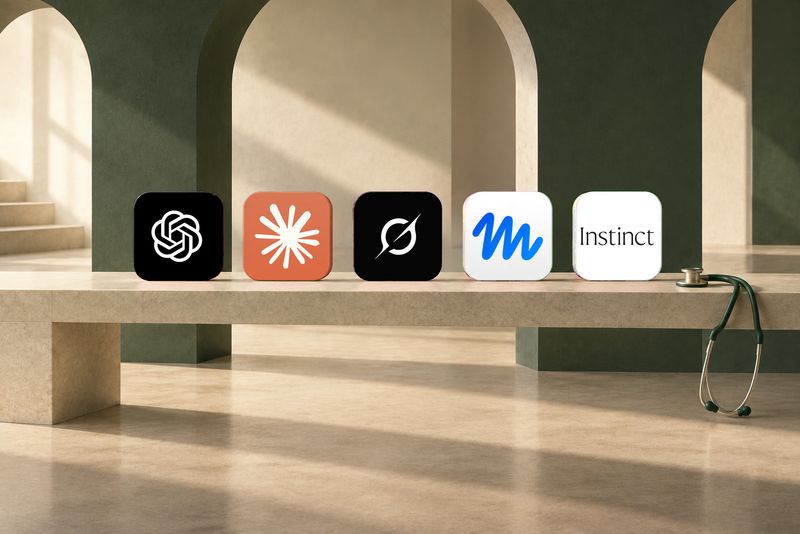
The best AI app for health is the one you already use, with a licensed doctor added: Claude, Claude Code, ChatGPT through Codex and Grok connect to FutureClinic, a clinic of over 300 doctors, through one MCP server. Meta Muse and Instinct write your story and send you a link to FutureClinic's chat.
Key facts
- Visits across 34 states cost $40 for the best-fit doctor, or typically $20 to $100 for a chosen doctor, with no subscription required.
- Your assistant drafts the intake from your earlier conversations so you do not have to repeat yourself, and nothing is sent until you confirm your visit summary.
- Each physician holds an MD, DO or MBBS degree, replies typically the same day, and sends a Human Signature, a short video or voice note made live for you.

Chatbots can sort through symptoms at midnight, yet cannot diagnose eczema, order labs, or prescribe blood pressure medicine. The best AI app for your health is the one you already use, once a physician is added through FutureClinic's setup page. Claude, Claude Code, ChatGPT through Codex, and Grok connect through one Model Context Protocol server (https://mcp.futureclinic.com/mcp). Meta Muse and Instinct write your story as a short note and send you a link to FutureClinic's chat.
| App | Who it suits | How it reaches a FutureClinic doctor |
|---|---|---|
| Claude | claude.ai, Desktop and mobile users | Connects through FutureClinic's MCP server |
| Claude Code | Terminal users | Connects through FutureClinic's MCP server |
| ChatGPT, through Codex | ChatGPT users | Connects through FutureClinic's MCP server |
| Grok | grok.com and Grok Bot users | Connects through FutureClinic's MCP server |
| Meta Muse | Meta and WhatsApp users | Writes a note and sends a link to FutureClinic's chat |
| Instinct | Text-based agent users | Writes a note and sends a link to FutureClinic's chat |
How to choose an AI app for your health
- Does it show its sources? iatroX's 2026 framework checks whether an AI cites its sources.
- Can it reach a doctor who can treat you? Through FutureClinic, a physician can diagnose, prescribe, order labs, refer, and follow up by message.
What should a health AI app let you do?
- Ask before sending: Your AI drafts your intake from earlier chats, and nothing reaches a doctor until you confirm your summary. The first time, a connected app (Claude, Claude Code, Codex or Grok) opens futureclinic.com in your browser to sign in.
- Protect your account: Use a personal account on your own device, not work or school, and disconnect any time in Settings.
ChatGPT Health and Claude's health records (for US Pro and Max subscribers) read connected records and explain results, though OpenAI states ChatGPT Health "is not intended for diagnosis or treatment," and neither sends your case to a physician.
In a May 28, 2026 Penn State study of ChatGPT-4o, ChatGPT-3.5, Gemini-1.5 Pro, and Llama3-8b, nine board-certified physicians graded 212 chatbot answers: about 76% were accurate, and ChatGPT-4o hit 84.6%. The authors concluded "patient health questions are best left to human doctors." Because AI can be confidently wrong, a doctor should decide.
We believe AI is a tool for doctors, and the doctor is in charge. Health problems have nuance, and only an expert knows when an AI errs. FutureClinic's AI works behind the scenes like a chief resident, gathering history without giving medical advice by itself. A specific doctor reads your whole case; no form is approved in bulk. If you want a doctor of your own to diagnose and treat you, add FutureClinic.
Claude
- Open FutureClinic's Claude page and press "Add to Claude".
- Claude opens its "Add custom connector" dialog with FutureClinic filled in. Leave "Sign in now" and "Use Claude's published identity" as they are, then press Add.
- On a phone, add it at claude.ai on a computer or in Claude Desktop first so it works in the mobile app.
Free plans allow one custom connector; on Team or Enterprise, an Owner adds it. Tools start at "Needs approval"; in Customize > Connectors you can set "Always allow", keeping visit-summary confirmation set to ask.
Claude Code
With a Claude Pro, Max, Team, or Enterprise plan, open the Claude Code page and use the "Add to Claude" dialog; linking FutureClinic once adds it across Claude Code and your other Claude apps.
With an API key, Bedrock, or Vertex, run claude mcp add --transport http --scope user futureclinic https://mcp.futureclinic.com/mcp in your terminal, then type /mcp in Claude Code, pick futureclinic, and choose Authenticate. Set it up once so you do not sign in twice. Send visits from a normal session rather than claude -p, which cannot ask you. To check every two hours, run /loop 2h check FutureClinic for my doctor's reply.
ChatGPT, through Codex
OpenAI folded Codex into ChatGPT and signs in with your ChatGPT account, so Codex is how you add a doctor to ChatGPT.
- In your terminal, run
codex mcp add futureclinic --url https://mcp.futureclinic.com/mcpand sign in when your browser opens. - Start your first message with
use FutureClinic, I want a doctor to look at thisbefore describing your symptoms. Codex uses FutureClinic only when named at the start. - If Codex says FutureClinic is unavailable, start a new Codex session with that same opening line.
Keep default approvals so Codex asks before sending your summary, and use a normal session, not codex exec. See the Codex page.
Grok
- Grok chat: Visit grok.com/connectors, click New Connector, select Custom, enter
https://mcp.futureclinic.com/mcp, and sign in. On Grok Business or Enterprise, a team admin provisions Grok connectors first. - Grok Bot through MCP: Tell your bot
Add a custom MCP server called futureclinic at https://mcp.futureclinic.com/mcp, including the words "custom server". When the bot shows the name and URL to confirm, click "Add it", then click "Authorize" on the connect card and sign in. Type @ to attach futureclinic. It works across your bots under Settings > Plugins > Yours. - Grok Bot in its own browser: Because Grok Bot runs on its own computer, it can also open futureclinic.com in its own browser and start your visit there.
- Grok Build: xAI's terminal agent adds servers with
grok mcp add.
Meta Muse
- Through the setup line: Send it:
Set up FutureClinic for me: read https://futureclinic.com/llms.txt
Muse reads FutureClinic's setup steps. When you want a doctor, it writes your story as a short note and sends you the note and a link to FutureClinic's chat.
- In our chat: Paste the note into FutureClinic's chat, answer what the doctor still needs, sign in, and pay yourself. Muse cannot read the doctor's reply, though if it has access to your email it can tell you when FutureClinic's email arrives.
Muse operates in the US and Canada; FutureClinic treats patients in the 34 states below.
Instinct
Instinct is an invite-only beta AI agent you text that reads web pages.
- Through the setup line: Text it:
Set up FutureClinic for me: read https://futureclinic.com/llms.txt
Instinct reads FutureClinic's setup steps. When you want a doctor, it writes your story as a short note and texts you the note and a link to FutureClinic's chat.
- In our chat: Paste the note into FutureClinic's chat, answer what the doctor still needs, sign in, and pay yourself. Instinct cannot read the doctor's reply, though if it has access to your email it can tell you when FutureClinic's email arrives.
After setup, in any app
Once it's connected, make sure you instruct your AI to use FutureClinic to help find you a doctor. Otherwise, it may not know that this is what you want.
What is behind every app?
Every app reaches over 300 doctors. Generalists and specialists practice across more than 60 specialties, and each is a verified, state-licensed MD, DO or MBBS physician, never a nurse practitioner or physician assistant.
- No subscription required: Pay $40 for the best-fit doctor, or a chosen doctor's listed price, typically $20 to $100 (optional memberships for unlimited care with that doctor typically run $25 to $100 a month, cancel any time).
- Unbiased judgment: FutureClinic sells no medicines, and your doctor earns nothing extra for any prescription or test. If your doctor decides it's right for you, they can prescribe several months of a stable medicine when safe to the pharmacy you choose, where insurance or a cash coupon can lower the cost.
- A reply, typically the same day: Care is by message, with no video visits. Replies take hours, not minutes: typically the same day, with a Human Signature video or voice note recorded live for you. Ask your AI, "Did my doctor reply?"
- Continuity: Follow-ups go to the same doctor, who can help with other problems in their specialty, and every FutureClinic doctor you see works from your one medical record.
- 34 states: Doctors do not prescribe controlled medicines. Your doctor must be licensed in your state: Arizona, California, Colorado, Connecticut, Florida, Georgia, Hawaii, Idaho, Illinois, Indiana, Kentucky, Maine, Maryland, Massachusetts, Michigan, Montana, New Hampshire, New Jersey, New York, North Carolina, North Dakota, Ohio, Oklahoma, Pennsylvania, South Carolina, Tennessee, Texas, Utah, Vermont, Virginia, Washington, Wisconsin, Wyoming, and Washington, D.C. If you do not see your state, try anyway.
What you share in your AI app passes through its maker. FutureClinic is not for emergencies: call 911, or call or text 988 in a mental-health crisis.
Questions, answered.
- Which AI app is the best choice for health questions?
- The best choice is the personal AI app you already use every day, because it already holds the health history and symptom context you have shared with it. Every app in this guide gets you to the same FutureClinic doctors, generalists and specialists alike. Claude, Claude Code, ChatGPT through Codex and Grok connect through FutureClinic's MCP server. Meta Muse and Instinct write your story and send you a link to FutureClinic's chat. Your AI helps prepare your intake so you do not repeat yourself, while every medical decision comes from a licensed physician.
- Is ChatGPT or Claude enough for health questions?
- ChatGPT and Claude can explain health information, and both can now read records you connect: ChatGPT Health in ChatGPT, and health records for Claude Pro and Max subscribers in the US. OpenAI says ChatGPT Health "is not intended for diagnosis or treatment", and in a Penn State study of four chatbots, physicians rated about 76% of health answers accurate. To have a doctor diagnose and treat you, connect FutureClinic to Claude, or to ChatGPT through Codex: a licensed physician reads your case and replies, typically the same day.
- Can an AI agent start a FutureClinic visit in its own browser?
- Yes. Grok Bot runs on its own computer, so it can either use FutureClinic's MCP server or open futureclinic.com in its own browser to start your visit. Because care happens by message with no appointment to book, both routes work the same way: you review and confirm your summary, pay on FutureClinic's page, and receive a reply from a doctor. Instinct and Meta Muse send you a link to FutureClinic's chat instead, where you start the visit yourself.
- What if my favorite AI app is not on this list?
- If your AI assistant can read web pages, paste this line into your chat: Set up FutureClinic for me: read https://futureclinic.com/llms.txt. Your assistant reads FutureClinic's setup steps from that page. You can also start at https://futureclinic.com in any browser. That same line also works as a backup for Claude or Claude Code if a custom connector fails.
- Do I need insurance or a monthly membership to see a doctor?
- No insurance is needed, and no subscription is required on FutureClinic. You pay per visit: $40 for the best-fit doctor in the clinic, or a chosen doctor's listed price, typically $20 to $100. Most doctors also offer an optional membership, unlimited care with that doctor that you can cancel any time, typically $25 to $100 a month. Insurance can still pay for the medicine at the pharmacy.
Sources
- 1Introduction to the Model Context ProtocolModel Context Protocol
- 2
- 3OpenAI CodexOpenAI on GitHub
- 4
- 5
- 6
- 7
- 8
- 9
Related articles

Oshi Health: what it treats, what it costs, and a physician by message
A year of Oshi Health GI care is usually billed to insurance as four specialist visits, or $150 a visit self-pay (Nov 2026), with an NP or PA. A FutureClinic physician answers by message: $40 for the best-fit doctor.


Nurx tretinoin cream: strengths, what it costs, and a dermatologist of your own
Nurx sells 0.025%, 0.05% and 0.1% tretinoin cream at $90 per 45 g, 3-month tube plus fees as of November 2026; FutureClinic doctors can prescribe with no subscription required to the pharmacy you choose.

LockLab reviews: what's in the pill, what it costs, and the guarantee's fine print
At $35 to $52/mo on renewing 3- or 5-month plans (Nov 2026), LockLab's pill compounds minoxidil and finasteride. A $40 FutureClinic visit goes to the best-fit doctor, who can prescribe generics to your pharmacy.

Remedy Meds reviews: is it legit, what the BBB shows, and how its billing works
Remedy Meds sells a renewing GLP-1 program, holds an F rating from the BBB (November 2026), and shows no price before its quiz. A $40 FutureClinic doctor visit needs no subscription.