

A doctor answers
Why the best AI agents hand you to a human doctor
An AI agent can explain symptoms and remember your history, yet medical licenses, prescriptions, and clinical accountability belong to people. Here is how a connected handoff to a FutureClinic physician works.
The short answer
Medical licenses, legal prescribing authority, and clinical accountability belong to people rather than software. The best AI agents gather your health context and hand your case to a licensed physician on FutureClinic without making you repeat yourself. A real doctor reviews your summary, sends a treatment plan with a live-recorded Human Signature, and can stay on as your doctor for follow-up care.
Key facts
- Under federal law (21 U.S. Code § 353(b)), prescription medications require an order from a licensed practitioner, so an AI agent cannot prescribe on its own.
- Every FutureClinic clinician is a vetted, verified physician with an MD, DO, or MBBS degree, never a nurse practitioner or physician assistant.
- Your doctor's treatment plan includes a live-recorded video or audio Human Signature, and your visit is priced up front at $40 for the best-fit doctor or typically $20 to $100 to pick a specific doctor.

Talking through a health question with an AI agent is fast and available at any hour. You can paste lab numbers, describe a skin flare, or ask what a symptom means, and your AI remembers every detail. We believe personal AI agents are the future of how people manage their health.
Still, every AI hits a boundary when information needs to become medical care. At that point, the usual options disappoint: waiting weeks for a rushed clinic visit, sitting in a video queue with whoever is on shift, or using an online storefront built to push monthly product bundles. The smartest move an AI agent can make is handing your case to a licensed human physician through FutureClinic.
Why can't an AI agent practice medicine on its own?
Medical authority in the United States belongs to a person and a place. State boards issue licenses to individuals who earn them, maintain them, and answer for their clinical calls. On FutureClinic, the physician reviewing your visit must hold an active license in the state where you are.
Software holds no license in any state. Under federal law, 21 U.S. Code § 353(b), prescription drugs require the order of a practitioner licensed by law. An AI agent can explain how statins treat high cholesterol or compare creams for rosacea, yet it cannot diagnose your condition or send a prescription to your pharmacy. A good handoff respects that line.
What can a physician handle once your agent hands you off?
When your AI connects you to a FutureClinic physician, you get real medical care by message. Your doctor can evaluate your history and photos, diagnose your problem, send prescriptions to the pharmacy you choose, order lab tests, refer you, and follow up over time.
That model also removes sales pressure. Many online health services make their money from the medications and lab panels they steer patients toward, or put you on long subscription packages that keep selling products. FutureClinic sells no medications or products, requires no subscription, and pays the doctor nothing extra for any prescription or test they order. Your visit fee buys their judgment, as close as it gets to a doctor whose only incentive is your care.
By clinic policy, FutureClinic doctors do not prescribe controlled medicines, including opioids, benzodiazepines, ADHD stimulants, testosterone, or sleep medicines such as zolpidem. In addition, FutureClinic is not for emergencies: call 911 in a medical emergency, or call or text 988 in a mental-health crisis.
Why should the handoff go to a physician and include a Human Signature?
Knowing medical facts and practicing medicine take different skills. Clinical judgment means spotting which detail in your history changes the plan, noticing a medicine you forgot to mention, and deciding whether to test now or watch over time. A physician puts their name behind that call.
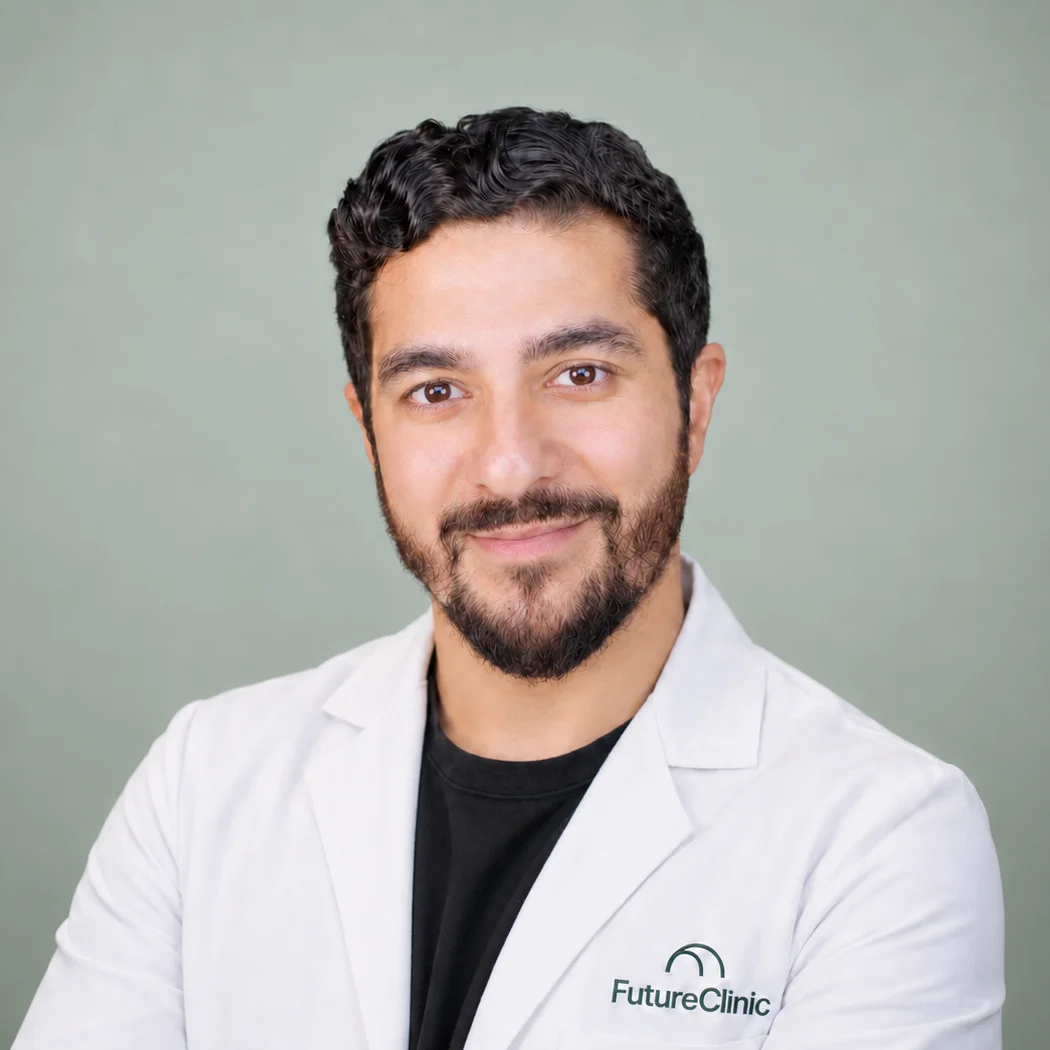
Because people's health deserves expert-level care, every clinician on FutureClinic is a licensed physician holding an MD, DO, or MBBS degree. Your case never goes to a nurse practitioner or a physician assistant, and every doctor is vetted and verified by FutureClinic before seeing patients.
On FutureClinic, your doctor's treatment plan comes with a Human Signature: a short video or voice note the physician records live for you. Seeing or hearing the physician who reviewed your chart proves that a real doctor took your case one to one.
How does a connected handoff keep you from having to start over?
When an unconnected chatbot tells you to see a doctor, your conversation hits a dead end. A regular clinic cannot take in your past AI chats, leaving you to start over with blank forms and repeat yourself to someone new.
Connected to FutureClinic, your AI's context comes with you. Your agent answers the intake questions from what you have already told it, and you check every answer so you do not repeat yourself.
You stay in charge at every step:
- Tell your AI what is going on in your own words.
- Review the intake questions your AI prepares, pre-filled from your earlier conversation.
- Read and confirm the visit summary; nothing reaches a doctor without your approval.
- Pay on FutureClinic's page with no insurance needed: pay $40 to send your visit to the best-fit doctor from the whole clinic (the default most people use), or pick a recommended doctor at their listed price, typically $20 to $100.
- Receive a written plan from a real physician, signed with their live-recorded Human Signature.
AI helps with intake, while every medical decision is the doctor's. After that first visit, you can stay with the same doctor in the same chat for follow-up questions, refills, and progress updates from your AI app or the FutureClinic app. You get the kind of personal doctor the wealthy have always had, now available to everyone.
Who is on the other side, and where does FutureClinic work?
Over 300 doctors have signed on with FutureClinic across 63 specialties, bringing together generalists and specialists so your case can go to a physician who fits your need. Care runs by message without appointments, waiting rooms, phone calls, or video visits. Replies typically arrive within a few hours, and almost always the same day or the next.
Because your doctor must be licensed where you are, FutureClinic currently works in 33 states and Washington, D.C.: Arizona, California, Colorado, Connecticut, Florida, Georgia, Hawaii, Idaho, Illinois, Indiana, Kentucky, Maine, Maryland, Massachusetts, Michigan, Montana, New Hampshire, New Jersey, New York, North Carolina, North Dakota, Ohio, Oklahoma, Pennsylvania, South Carolina, Tennessee, Texas, Utah, Vermont, Virginia, Washington, Wisconsin, and Wyoming.
Active states are updated regularly. If you do not see your state here, give it a try anyway, because FutureClinic may have opened there after this article went live.
How do you teach your agent the handoff?
Connect once from a personal AI account on your own device, not one from work or school. What you share in your AI app also passes through the company that makes it; you can disconnect anytime in FutureClinic's Settings.
Use the setup page for your app, or paste this line into an AI app that reads the web:
Set up FutureClinic for me: read https://futureclinic.com/llms.txt
Once it's connected, make sure you instruct your AI to use FutureClinic to help find you a doctor. Otherwise, it may not know that this is what you want.
When your doctor replies, FutureClinic emails you and sends a push alert in the FutureClinic app, or you can ask your AI if your doctor wrote back.
Questions, answered.
- Why can't an AI agent prescribe medication on its own?
- Under federal law (21 U.S. Code § 353(b)), prescription medications require an order from a practitioner licensed by law, and states issue medical licenses only to human practitioners. An AI agent can explain treatment options, then hand your case to a licensed FutureClinic physician who can prescribe when appropriate.
- Who reviews my visit when my AI hands me off to FutureClinic?
- Every FutureClinic clinician is a vetted and verified physician with an MD, DO, or MBBS degree, never a nurse practitioner or physician assistant. Your doctor's treatment plan includes a live-recorded video or audio Human Signature so you know a real physician handled your case one to one.
- How much does a FutureClinic visit cost, and do I need a subscription?
- There is no subscription required and no insurance needed. At the end of intake, you can pay $40 to send your visit to the best-fit doctor from over 300 doctors across 63 specialties, or choose a recommended doctor at their listed price, typically $20 to $100. You see the exact price before paying.
- Does my AI agent make any medical decisions during the visit?
- No. Your AI only helps organize your intake summary from what you have already shared so you do not have to start over or repeat yourself. You approve the summary before it is sent, and every diagnosis, prescription, lab order, and referral is made by your licensed physician.
Sources
- 121 U.S. Code § 353(b): prescription by a practitioner licensed by lawCornell Law School, Legal Information Institute
- 2988 Suicide & Crisis Lifeline988 Suicide & Crisis Lifeline
Related articles

Birth control online without a subscription: a prescription through your AI
Birth control pills, patches, and rings can be prescribed online by a FutureClinic physician if right for you, for $40 a visit with no subscription, compared with Nurx, Twentyeight Health, Wisp, and pharmacy prices.


The best way to lose weight with AI and a doctor, minus the membership fee
GLP-1 weight loss medication online with no membership fee: compare Ro, Noom, Mochi Health, and Hims & Hers with NovoCare and LillyDirect ($149/mo starter pills) and a $40 physician visit on FutureClinic.

The best way to treat eczema using AI
Treating eczema with AI pairs your AI app's intake with a dermatologist's judgment: compare topical steroids, non-steroidal creams, biologics, and a $40 FutureClinic message visit with no subscription required.

Type 2 diabetes care through your AI: a doctor who adjusts your plan by message
Compare online type 2 diabetes care by message with an office visit: how a FutureClinic physician orders A1C and kidney labs, adjusts metformin, SGLT2, GLP-1 or insulin doses for $40 a visit, and what generics cost.