

Why Your Acne Treatment Isn't Working Yet: A Beginner's Guide
Starting an acne treatment and seeing nothing happen is frustrating, but it's rarely a sign the treatment has failed. A dermatologist breaks down why results take longer than expected, what purging actually means, and the most common mistake that quietly undermines most routines.

Medically reviewed by Dr. Dennis Porto · Updated August 2026
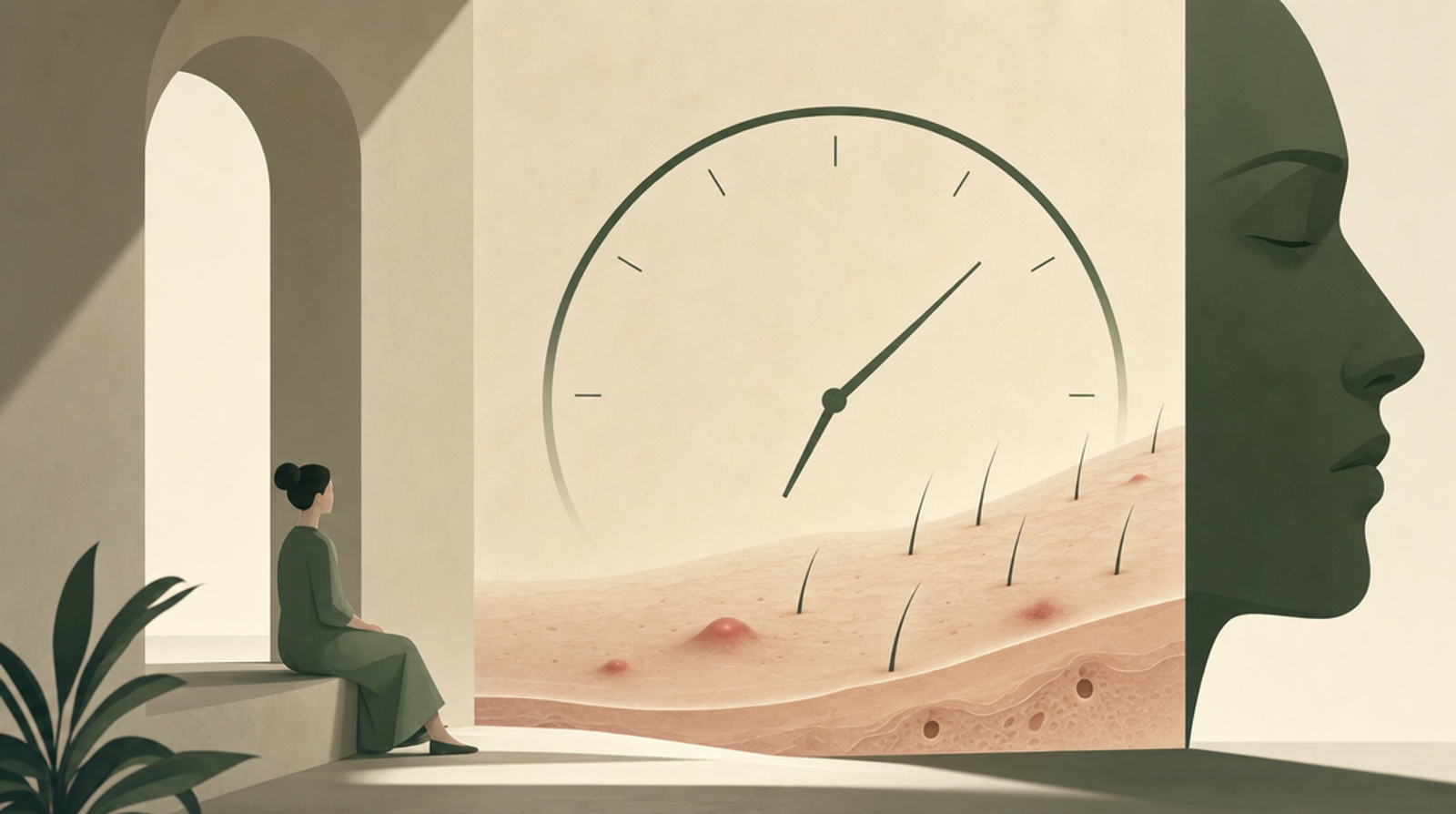
Most acne guides on the internet assume you already know how acne treatment works. They jump straight into product recommendations, ingredient breakdowns, and ten-step routines. But if you're reading this, you're probably in a different spot: you started something, it doesn't seem to be doing much, and you're not sure whether to wait it out, switch products, or give up entirely. That's the most common place people get stuck, and it's almost never because the treatment itself failed. This is the plain-language version of what's actually going on, written by a dermatologist who has this conversation in clinic constantly.
What you actually need to know
- Most acne treatments take 8 to 12 weeks to show clear results. Your skin's outer layer turns over every 28 to 40 days. The treatment is changing what's being built underneath, but the old skin has to cycle out on its own timeline. Three weeks is not enough time to judge anything.
- The most common reason a treatment "fails" is how it's being used, not what it is. Spot-treating individual pimples instead of applying to the full face is the biggest mistake, and almost nobody realizes they're making it.
- Your skin can look worse before it looks better. With retinoids like tretinoin, purging is real. The treatment speeds up cell turnover, which pushes stuff that was brewing under the surface up faster. That's the treatment working, not failing.
- Effective acne treatment does not need to be expensive. Generic tretinoin, generic benzoyl peroxide, generic clindamycin. These are the workhorses, and they've been around for decades. The $80 serum at Sephora is usually not adding anything a $15 generic doesn't already do.
- Not everything that looks like acne is acne. If nothing is working at all, one real possibility is that the bumps are something else entirely.
Wait, am I in the right place?
This article is for you if you've been using an acne treatment for a few weeks (or a few months), you're not seeing what you expected, and you're trying to figure out whether the treatment is wrong, you're doing something wrong, or you just need to wait longer. If you've never tried any treatment and you're starting from scratch, this still applies. It'll help you set realistic expectations before you begin.
If you've already been through multiple treatments over years and you're weighing bigger decisions like isotretinoin, you're past the beginner stage. A deeper conversation with a dermatologist about escalation would serve you better than this guide.
What's actually going on?
Acne treatment doesn't work the way most people picture it. It's not like putting antibiotic ointment on a cut. You're not healing individual pimples. You're changing the environment across your entire skin surface so that new breakouts stop forming.
Your epidermis turns over roughly every 28 to 40 days. The skin you see in the mirror today started forming about a month ago. When you start a treatment, it goes to work on the new cells being produced underneath. But the old skin, already inflamed, already clogged, still has to work its way out on its own schedule. You can't speed that up.
Think of it like a factory. The treatment is changing what comes off the production line, but the stuff that was already manufactured and sitting on the shelf still has to move through. That's why results take weeks to months, not days.
With tretinoin specifically, there's an added layer: purging. Tretinoin accelerates that cell turnover, so things that were brewing under the surface get pushed up faster than they normally would. Your skin can genuinely look worse in weeks two through six. That's not a sign the medication isn't working. That's the medication working on a timeline your eyes haven't caught up to yet.
The terms you're going to hear
- Tretinoin (retinoid). A vitamin A derivative that speeds up skin cell turnover and is one of the most effective long-term acne treatments. It's the generic version of what used to be sold as Retin-A.
- Benzoyl peroxide. An over-the-counter topical that kills acne-causing bacteria. Unlike antibiotics, bacteria don't develop resistance to it.
- Clindamycin. A topical antibiotic commonly prescribed for inflammatory acne. Applied to the full face, not individual spots.
- Isotretinoin. The strongest systemic acne medication available, taken by mouth. Often known by the old brand name Accutane. Reserved for moderate-to-severe acne or cases that haven't responded to other treatments.
- Purging. A temporary increase in breakouts when starting a retinoid, caused by accelerated cell turnover pushing existing clogs to the surface faster.
- Comedone. A clogged pore. Blackheads are open comedones; whiteheads are closed comedones.
- Inflammatory vs. non-inflammatory acne. Inflammatory acne involves red, swollen bumps (papules, pustules, cysts). Non-inflammatory acne is blackheads and whiteheads without redness or swelling.
- Topical vs. oral. Topical means applied to the skin. Oral means taken by mouth. Most people start with topicals; oral medications are the next step if topicals aren't enough.
What the typical path looks like
A dermatologist evaluating your acne will look at what type of acne you have (inflammatory vs. non-inflammatory, mild vs. moderate vs. severe), what you've tried, how you've been using it, and whether there are any early signs of response.
For most mild-to-moderate acne, the starting point is topical treatment, usually some combination of a retinoid, benzoyl peroxide, and sometimes a topical antibiotic. The realistic timeline for visible improvement is 8 to 12 weeks of consistent, correct use.
Around week 8, a dermatologist reassesses. Maybe the concentration gets adjusted, a second agent gets added, or the routine gets tweaked based on how your skin is responding. If topicals aren't moving the needle after a fair trial, the next step is usually an oral medication, commonly doxycycline. If that doesn't work either, or if scarring is already happening, isotretinoin enters the conversation.
The part most people don't hear: this process involves some trial and error. The goal isn't to get it perfect on the first try every time. It's to keep adjusting until the right combination clicks for your specific skin. A dermatologist staying with you through that process is what makes it work. They see how you're responding and pivot accordingly.
All of this, the initial evaluation, prescriptions, lab orders, follow-up adjustments, can happen through a chat consultation. If something genuinely needs an in-person look (which is less common than most people assume), your dermatologist can recommend that step when it's actually necessary.
What to actually do next
- Check your application technique first. If you're dabbing your treatment onto individual pimples, switch to applying it across the entire face. This is the most common fixable mistake.
- Give it a real timeline. If you've been on a treatment for less than 8 weeks and you're not seeing dramatic results, that's expected. The early sign that tells you it's working before your skin fully clears: the rate of new breakouts slows down. You might still have existing spots resolving, but fewer new ones forming means the treatment is doing its job.
- Simplify your skincare. When acne isn't improving, the instinct is to add more products, scrub harder, layer on actives. That usually makes things worse. Gentle cleanser, simple moisturizer, sunscreen. That's it. Your acne treatment does the heavy lifting; your skincare routine's job is to not get in the way.
- Track what's happening. Take a photo of your skin once a week in the same lighting. Progress is hard to see day-to-day but obvious when you compare week 1 to week 8.
If you're deciding whether to talk to a doctor
If you've been trying to sort this out on your own with drugstore products and internet advice, and it's been a few months without real progress, that's a reasonable point to get a dermatologist involved. The most common reason people don't is the logistics: scheduling weeks out, taking time off, sitting in a waiting room for a 15-minute visit.
On FutureClinic, the consultation is real healthcare. A real dermatologist reviewing your case, writing prescriptions, ordering labs if needed, just through chat. You start it from your phone whenever you're ready, send photos of your skin, describe what you've tried, and get a personalized plan back, usually the same day. The same doctor stays with you for follow-ups, so when it's time to adjust the approach at week 8, you message them directly instead of rebooking from scratch.
You can keep trying to piece together the right routine from Reddit threads and product reviews, or you can spend the same fifteen minutes in a chat with a dermatologist who can actually look at your skin, tell you what you're dealing with, and write the prescription if that's the right call. Most people who finally do this say the same thing: they wish they'd done it months earlier instead of guessing.
Common mistakes new patients make
- Quitting at week 3 because "it's not working." Three weeks is not a fair trial for any acne treatment. Your skin hasn't even completed one full turnover cycle yet. The patients who get results are the ones who stay consistent through the boring middle stretch.
- Spot-treating instead of applying to the full face. Acne medications change the environment across your skin. Dabbing clindamycin on individual pimples is like watering one plant in a garden and expecting the whole yard to grow. Full-face application, every time.
- Adding more products when the current ones aren't "working fast enough." Layering a salicylic acid wash, a glycolic toner, a retinol serum, and a benzoyl peroxide spot treatment all at once is a recipe for a damaged skin barrier, not faster clearing. Pick a regimen, keep the rest simple, and let it work.
- Assuming expensive products work better than cheap ones. Generic tretinoin and brand-name tretinoin are the same molecule. Your skin doesn't know which one cost more, and the clinical outcomes are identical. The medications that actually treat acne are boring, generic, and cheap.
- Booking a spa facial as the "next step." Facials feel great, but for acne they often don't help and can make things worse. Aggressive extractions cause more inflammation, and the products used during facials aren't calibrated for acne-prone skin. If your acne isn't responding, the next step is a dermatologist, not a spa.
Frequently asked questions
Is my diet causing my acne?
Diet is unlikely to be the main driver of your acne. There's some very preliminary research suggesting high-glycemic diets might play a minor role for some people, but for the vast majority of patients, acne is driven by hormones, genetics, and the behavior of your oil glands and skin cells. Overhauling your diet instead of starting an actual treatment is, in most cases, delaying the thing that would actually help.
Can acne go away on its own?
It can, but there's no guarantee of when. Some people's acne resolves in their early 20s; others deal with it into their 30s and 40s. The genetic factors that determine this aren't well understood yet. Waiting it out is a gamble, and if scarring is happening in the meantime, those marks are permanent even after the acne eventually clears.
Is isotretinoin dangerous?
Isotretinoin is a serious medication that requires monitoring, but it's not the boogeyman social media has made it. It has real side effects: dry skin, dry lips, possible mood changes that need monitoring. It requires lab work and medical supervision [per AAD acne management guidelines]. But with appropriate oversight from a board-certified dermatologist, it's safe, and it's the most effective acne treatment available. The fear-mongering online keeps some patients from even considering it when they're exactly the ones who would benefit most.
What if my treatment genuinely isn't working after a fair trial?
That's information, not a dead end. Not every skin responds to every medication the same way. If a topical regimen hasn't moved the needle after 8 to 12 weeks of correct use, the next step is escalation: adding an oral antibiotic, switching the topical approach, or discussing isotretinoin. A dermatologist who stays with you through this process can adjust in real time rather than starting from scratch each visit.
Is acne hereditary?
There's a strong hereditary component. If your parents had acne, your odds go up significantly. We don't fully understand the specific genetic mechanisms yet, including why some people respond to a treatment in four weeks while others take four months on the same regimen, but the family-history link is well established [per Zaenglein AL et al., J Am Acad Dermatol, 2016].
Do I need to wash my face more?
No. Acne is not caused by dirty skin. Over-washing and scrubbing can actually damage your skin barrier and make acne worse. A gentle cleanser twice a day is enough. The heavy lifting is done by your treatment, not your cleanser.
How do I know if my bumps are actually acne?
If nothing you've tried has made any difference at all, it's worth questioning the diagnosis. Sebaceous hyperplasia (small yellowish bumps), milia (tiny hard white bumps), and flat warts can all look like acne but don't respond to acne medications. A dermatologist can tell the difference. Sometimes the "treatment failure" is actually a misidentification, and the fix is recognizing what you're actually dealing with.
Will my acne ever fully go away?
With the right treatment, basically any acne can be treated into remission. The path might involve some trial and error, and it won't happen overnight. But the idea that some people just "have acne" and nothing can be done is not true. Consistency is the most important part of improvement, and it's entirely under your control.
This article is intended as educational information, not personal medical advice. For one-to-one guidance on your specific situation, talk to your own doctor or start a chat consultation with a FutureClinic doctor and get a real, personalized answer for your case.
Bottom line
Most acne treatment "failures" aren't failures at all. They're timing issues, application mistakes, or expectations that haven't caught up to how skin biology actually works. The fix is usually simpler than people expect: apply to the full face, stay consistent, give it a real timeline, and keep the rest of your routine boring. If you've done all of that and things still aren't moving, that's the point where a dermatologist adjusts the plan. Not where you give up.
If you want a personalized plan for your acne, you can start a chat consultation with me through FutureClinic. Same doctor, same thread, same-day response, and we adjust together until it works.
Dr Dennis Porto is a board-certified dermatologist and board-certified Mohs surgeon. He is an Assistant Clinical Professor at Mount Sinai where he teaches skin cancer surgery. He is the founder of SkinCare.MD. He is a graduate of the University of Iowa, Henry Ford Hospital, and Harvard.
References
- Zaenglein AL, Pathy AL, Schlosser BJ, et al. Guidelines of care for the management of acne vulgaris. J Am Acad Dermatol, 2016;74(5):945-973.
- Leyden JJ. A review of the use of combination therapies for the treatment of acne vulgaris. J Am Acad Dermatol, 2003;49(3 Suppl):S200-S210.
- Tan J, Boyal S, Engstrom AM, et al. Acne treatment outcomes and patient satisfaction. J Eur Acad Dermatol Venereol, 2020;34(Suppl 4):3-7.
- Layton AM, Eady EA, Whitehouse H, et al. Oral isotretinoin as first-line therapy in severe acne with scarring. Br J Dermatol, 2006;154(1):109-114.
- American Academy of Dermatology. Acne: tips for managing. AAD Patient Resources, 2024.
Frequently asked questions
- How long does acne treatment take to work?
- Most acne treatments take 8 to 12 weeks to show clear results. The skin's outer layer turns over every 28 to 40 days, so even when a treatment is working, the old skin has to cycle out on its own timeline before you see improvement. Three weeks is not enough time to judge anything.
- Why does my skin look worse after starting a retinoid?
- This is called purging, and it's a sign the treatment is working, not failing. Retinoids like tretinoin speed up cell turnover, which pushes congestion that was already forming under the surface up faster. The breakout wave is temporary and typically settles within the first 4–8 weeks.
- What's the most common mistake people make with acne treatment?
- Spot-treating individual pimples instead of applying the treatment across the full face. Acne treatment works by changing the skin environment to prevent new breakouts from forming — not by healing existing ones. Applying it only to visible spots means the rest of the face keeps producing new breakouts unchecked.
- Do I need to spend a lot on acne products?
- No. Generic tretinoin, benzoyl peroxide, and clindamycin are the clinical workhorses for acne and have decades of evidence behind them. Expensive branded serums rarely add anything that a lower-cost generic doesn't already do.
- What if nothing is working at all?
- If no acne treatment has made any difference, one possibility is that the bumps aren't acne. Conditions like folliculitis, milia, or perioral dermatitis can look similar but don't respond to standard acne treatments. A dermatologist can help confirm the diagnosis before you continue trying products.
Related articles

When OTC Acne Products Stop Working, What Should You Actually Do Next?
Most OTC acne products don't stop working; they were never matched to the right type of acne in the first place. Here's how to tell when you've given them a fair shot and what a dermatologist can actually do differently.
OTC Acne Products vs. Prescription Acne Treatment: How to Know When You Need a Dermatologist
Cycling through drugstore acne products without results usually isn't a product problem; it's a signal that your acne has outgrown what OTC can offer. Here's how to tell where you sit on that line, and what the prescription tier actually adds.
Acne: A Complete Dermatologist's Guide
Acne isn't one condition; it's at least three, and treating the wrong subtype is why most OTC products seem to stop working. This guide covers how to identify comedonal, inflammatory, and hormonal acne, and what prescription treatment looks like when it's done right.
Why Did My Acne Products Stop Working? A Dermatologist Walks Through It
Cycling through drugstore acne products without results usually isn't a product problem; it's a targeting problem. A dermatologist breaks down why most OTC routines stall and what it takes to actually clear your skin.