

Why Isn't My Acne Treatment Working Yet?
Most acne treatments need 8 to 12 weeks of consistent, correct use before they can be fairly judged. If you're dabbing medication on individual spots or quitting at week three, the treatment hasn't actually had a real chance yet.

Medically reviewed by Dr. Dennis Porto · Updated August 2026
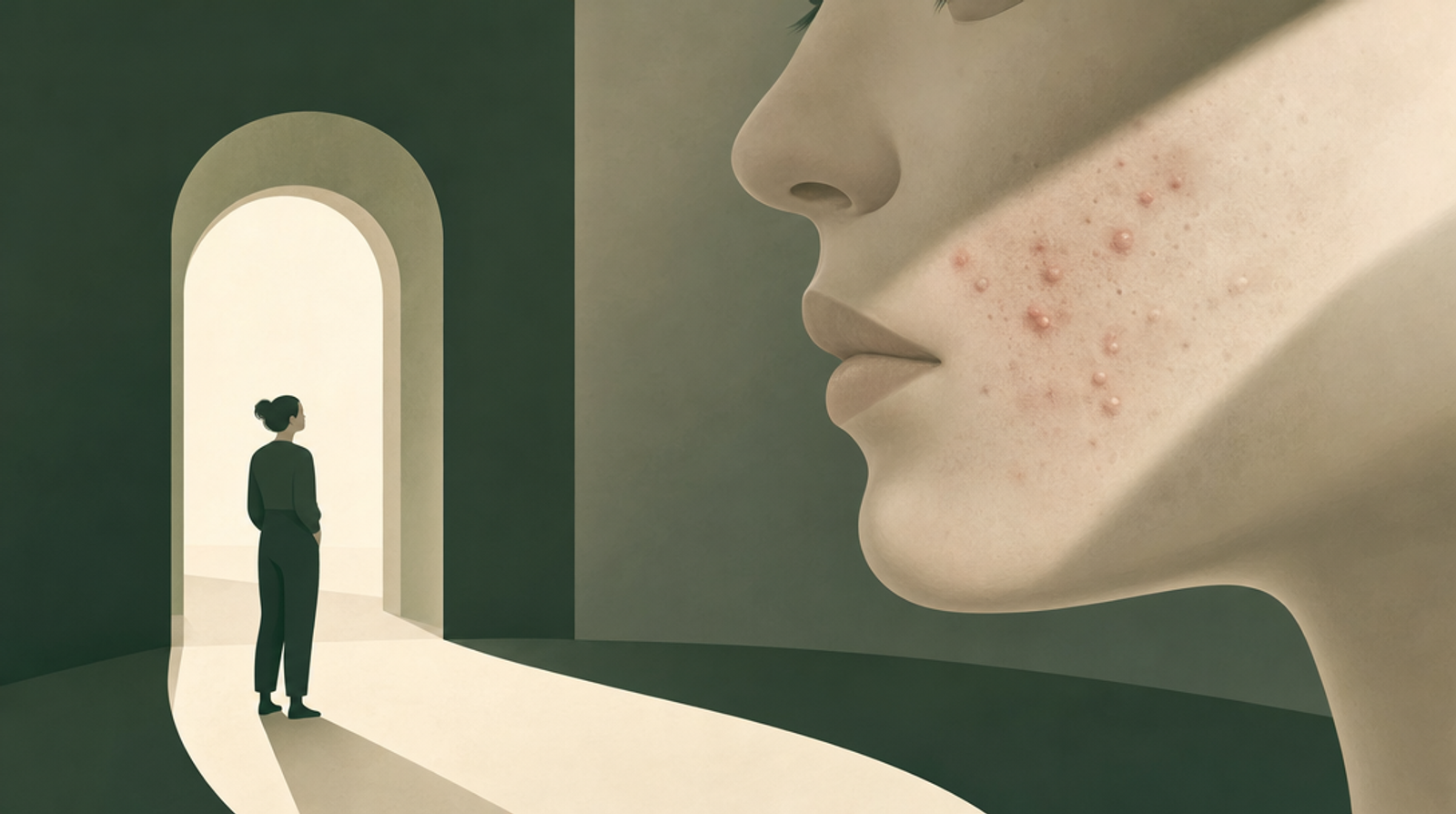
Most acne treatments need 8–12 weeks of consistent, correct use before you can fairly judge them. If you quit at week three or you've been dabbing medication on individual pimples instead of applying it across your entire face, the treatment hasn't actually had a real shot yet.
The short answer
The two most common reasons an acne treatment "isn't working" are quitting too early and using it wrong. Acne medications change the behavior of your skin over an entire turnover cycle, roughly 28 to 40 days, which means visible improvement takes weeks to months, not days. And most topical acne treatments (clindamycin, benzoyl peroxide, tretinoin) need to be applied to the full face, not spot-treated onto individual breakouts. If you've been doing either of those things, the treatment probably hasn't failed. It just hasn't been given a fair trial yet.
What's actually going on?
Your skin's outer layer, the epidermis, replaces itself roughly every 28 to 40 days. The skin you're looking at right now started forming about a month ago. When you start an acne treatment, it's working on the new cells being produced underneath, but the old skin that's already inflamed and clogged has to cycle out on its own timeline. You can't rush that part.
With tretinoin specifically, your skin can actually look worse before it looks better. Tretinoin speeds up cell turnover, which pushes stuff that was brewing under the surface up faster. That initial "purge" in weeks two through four is the treatment working on a timeline your eyes haven't caught up to yet. It's not a sign of failure. It's a sign of acceleration.
The spot-treatment mistake is even more straightforward. Acne medications work by changing the environment across your entire skin surface, reducing oil production, killing bacteria, preventing new clogs from forming. Dabbing clindamycin on a single pimple is like mopping one tile when the whole floor is wet. The pimple you're treating might improve, but three new ones are forming in the untreated areas because nothing changed there.
When does the answer change?
If you've been using a treatment correctly, full face, consistent application, right frequency, for a full 12 weeks and you're seeing zero improvement, the answer shifts. At that point, it's not a patience problem. A few possibilities:
- It might not be acne. Sebaceous hyperplasia (small yellowish bumps), milia (tiny white keratin cysts), and flat warts can all look like acne but won't respond to acne medications. I've seen patients treat flat warts with benzoyl peroxide for months before someone looked closely enough to realize what was actually going on.
- Your skin may need a different medication or a stronger one. Not every person responds to the same treatment the same way. Moving from topicals to an oral antibiotic, or from an oral antibiotic to isotretinoin, isn't a failure. It's information. Now we know what your skin doesn't respond to, and we can move forward with more confidence.
- If you're already scarring, waiting on the standard stepladder may not be the right call. The typical approach says start with topicals, wait, escalate to oral antibiotics, wait again, then consider isotretinoin. But scarring is permanent. If acne is leaving marks that won't resolve on their own, I think it's reasonable to have the isotretinoin conversation earlier rather than spending six months climbing a ladder while the scarring gets worse.
What should you actually do?
- Apply your treatment to your entire face, not just individual spots. This is the most common fix. Full coverage, every time.
- Give it 12 full weeks before deciding it's not working. The early sign that a treatment is doing its job: the rate of new breakouts slows down. You might still have existing spots resolving, but fewer new ones forming means the medication is working on the factory floor.
- Use benzoyl peroxide 5% if you haven't tried a prescription yet. It's available everywhere, it's cheap, and it genuinely works. It kills acne-causing bacteria without building resistance the way antibiotics can. Full face, not spot treatment.
- Keep the rest of your routine simple. Gentle cleanser, basic moisturizer, sunscreen. When acne isn't improving, the instinct is to add more products and scrub harder. That usually makes things worse. Your acne treatment does the heavy lifting. Your skincare routine's job is to stay out of the way.
- Skip the spa facial. I know they feel great, but for acne they rarely help and can make things worse. Aggressive extractions cause more inflammation, and the products used during facials aren't calibrated for acne-prone skin.
When is this worth asking a doctor about?
If you've given a treatment a fair 12-week trial with correct application and you're still not seeing progress, or if your acne is leaving scars, that's worth a real conversation with a dermatologist. Not a Google deep dive, not another product swap. An actual clinical assessment of what's going on with your skin and what the right next step is.
That's a chat consultation: real healthcare, real dermatologist, real prescriptions if that's what fits, just through chat, on your phone, whenever you're ready. You'll usually have a response back the same day, and the same doctor stays with you if you need to adjust the plan down the road.
Frequently asked questions
Is my diet causing my acne?
Unlikely to be the main driver. There's some preliminary research suggesting high-glycemic diets might play a minor role for some people, but for the vast majority of patients, acne is driven by hormones, genetics, and oil-gland behavior. Overhauling your diet instead of starting an actual acne treatment is, in most cases, delaying the thing that would actually help.
Does the "purge" mean my treatment is making things worse?
No. Purging means the treatment is accelerating what was already brewing under the surface. With tretinoin, the first two to four weeks can bring new breakouts to the surface faster than they would have appeared on their own. That's the medication speeding up cell turnover, not creating new problems. Purging typically resolves by weeks six to eight [per AAD acne treatment guidelines].
Can I use expensive acne products instead of generics?
You can, but you probably don't need to. Generic tretinoin, generic clindamycin, generic benzoyl peroxide: these are the medications that actually clear acne, and they've been around for decades. Your skin doesn't know the difference between a branded formulation and its generic equivalent. Basically any acne can be treated into remission with generic medicines.
How do I know if what I have isn't actually acne?
If nothing you've tried has made any difference after consistent use, consider that the diagnosis might be wrong. Look-alikes include sebaceous hyperplasia (yellowish dome-shaped bumps), milia (tiny hard white bumps that don't pop), and flat warts (small flat-topped bumps that spread). A dermatologist can tell the difference, and if you're treating the wrong condition, no acne medication is going to help.
Will my acne ever actually go away?
Yes. With the right treatment, basically any acne can be treated into remission. The path might involve some trial and error, and it won't happen overnight, but the idea that some people just "have acne" and nothing can be done isn't true. If what you're on isn't working, the answer is to adjust and escalate, not to give up. Consistency is the most important part of improvement, and it's entirely under your control.
Bottom line
Most acne treatment "failures" are really timing failures or application failures. Give the medication 12 weeks, apply it to your full face, and keep the rest of your routine boring. If you've done all of that and you're still stuck, or if scarring is in the picture, it's time to talk to a dermatologist about what comes next.
If you want a personalized plan for your acne, you can start a chat consultation with me through FutureClinic. Same-day response, same doctor for the follow-up, no scheduled appointment required.
This article is intended as educational information, not personal medical advice. For one-to-one guidance on your specific situation, talk to your own doctor — or start a chat consultation with a FutureClinic doctor and get a real, personalized answer for your case.
Dr Dennis Porto is a board-certified dermatologist and board-certified Mohs surgeon. He is an Assistant Clinical Professor at Mount Sinai where he teaches skin cancer surgery. He is the founder of SkinCare.MD. He is a graduate of the University of Iowa, Henry Ford Hospital, and Harvard.
References
- Zaenglein AL, Pathy AL, Schlosser BJ, et al. Guidelines of care for the management of acne vulgaris. J Am Acad Dermatol, 2016;74(5):945-973.
- Leyden JJ, Del Rosso JQ, Webster GF. Clinical considerations in the treatment of acne vulgaris and other inflammatory skin disorders: focus on antibiotic resistance. Cutis, 2007;79(6 Suppl):9-25.
- Strauss JS, Krowchuk DP, Leyden JJ, et al. Guidelines of care for acne vulgaris management. J Am Acad Dermatol, 2007;56(4):651-663.
- American Academy of Dermatology. Acne: diagnosis and treatment. 2024.
Frequently asked questions
- How long should I give an acne treatment before deciding it isn't working?
- At least 8–12 weeks of consistent, correct use. Acne medications work on your skin's full turnover cycle, which takes 28 to 40 days, so visible improvement takes weeks to months, not days. Quitting at week three means the treatment hasn't had a fair trial.
- Should I apply acne medication only to my pimples?
- No. Most topical acne treatments — including clindamycin, benzoyl peroxide, and tretinoin — need to be applied across the entire face, not spot-treated onto individual breakouts. They work by changing the skin environment broadly, preventing new clogs and reducing bacteria across the whole surface.
- Why does my skin look worse after starting tretinoin?
- This is known as the tretinoin purge. Tretinoin speeds up cell turnover, which pushes congestion that was forming under the surface up faster. Skin often looks worse in weeks two through four before it improves. This is a sign the treatment is working, not failing.
- What if I've used a treatment correctly for 12 weeks and nothing has changed?
- At that point it's no longer a patience problem. Possibilities include the wrong diagnosis (some bumps that look like acne, such as milia or flat warts, won't respond to acne medications), or a need for a stronger or different medication, such as an oral antibiotic or isotretinoin.
- When should I consider isotretinoin instead of waiting on standard treatments?
- If acne is already causing scarring, waiting through the standard stepladder of topicals and oral antibiotics may not be the right call. Scarring is permanent, so it's reasonable to discuss isotretinoin earlier if marks are forming that won't resolve on their own.
Related articles

When OTC Acne Products Stop Working, What Should You Actually Do Next?
Most OTC acne products don't stop working; they were never matched to the right type of acne in the first place. Here's how to tell when you've given them a fair shot and what a dermatologist can actually do differently.
OTC Acne Products vs. Prescription Acne Treatment: How to Know When You Need a Dermatologist
Cycling through drugstore acne products without results usually isn't a product problem; it's a signal that your acne has outgrown what OTC can offer. Here's how to tell where you sit on that line, and what the prescription tier actually adds.
Acne: A Complete Dermatologist's Guide
Acne isn't one condition; it's at least three, and treating the wrong subtype is why most OTC products seem to stop working. This guide covers how to identify comedonal, inflammatory, and hormonal acne, and what prescription treatment looks like when it's done right.

Why Did My Acne Products Stop Working? A Dermatologist Walks Through It
Cycling through drugstore acne products without results usually isn't a product problem; it's a targeting problem. A dermatologist breaks down why most OTC routines stall and what it takes to actually clear your skin.