

Why Isn't My Acne Treatment Working? A Dermatologist's Honest Guide
Most acne treatments don't fail because they're the wrong drug; they fail because of how, and how long, they're used. A dermatologist breaks down the real reasons skin isn't clearing, ranked by how often they actually show up in practice.

Medically reviewed by Dr. Dennis Porto · Updated August 2026
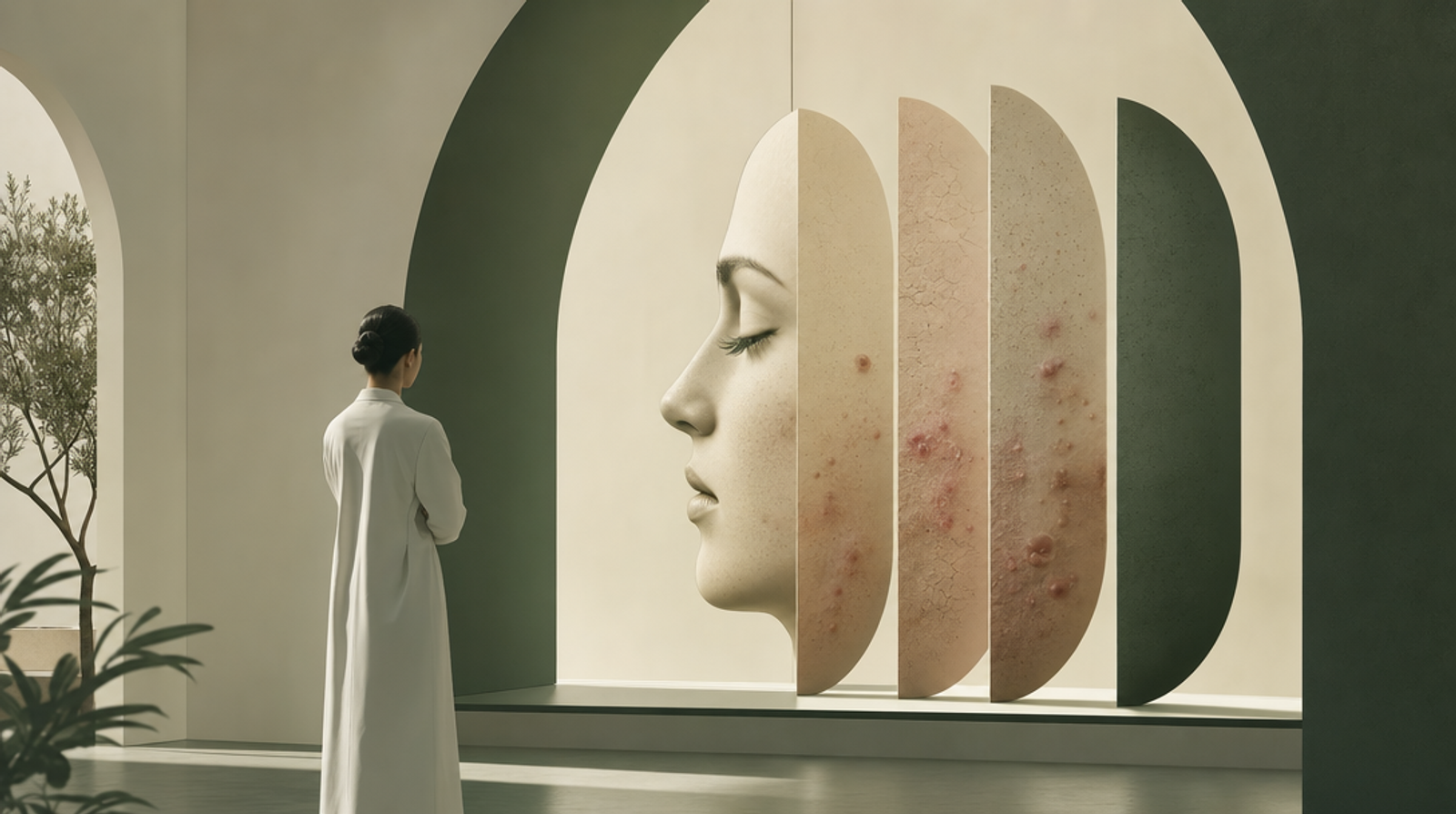
Most articles about acne treatment failure give you a list of twenty possible reasons and leave you to figure it out. This one does the opposite. I'll walk you through the reasons that actually account for most cases I see, the ones that get missed, and the signs that mean your skin needs a different approach, ranked by how often they're actually the problem.
What's the most common reason acne treatment doesn't work?
Most acne treatment "failures" aren't treatment failures at all. In the majority of cases I see, the treatment was either used incorrectly (most commonly applied only to individual pimples instead of the entire face) or abandoned too early, before the skin had time to respond. Acne medications work by changing the environment across your whole skin surface over weeks to months. They don't work like a spot treatment on a single pimple.
If you've been on a reasonable regimen for less than eight weeks and you're using it correctly across the full face, the most likely explanation for "not working yet" is that you haven't given it enough time. If you've been on it longer than that and you're applying it correctly, the next most likely explanations are wrong diagnosis, wrong medication for your pattern, or a regimen that needs escalation.
What "acne treatment not working" actually means
When people say their acne treatment isn't working, they usually mean one of a few things, and it helps to get specific:
- "I'm still breaking out." Are you breaking out at the same rate as before, or less frequently? A slower rate of new breakouts is the first sign a treatment is working, even if your skin doesn't look clear yet.
- "My skin looks worse than before I started." This can be purging, especially with tretinoin or other retinoids, where accelerated cell turnover pushes existing clogs to the surface faster. Purging typically peaks in weeks two through four and resolves by week six to eight.
- "Nothing has changed at all." After eight-plus weeks of correct, consistent use, this is the version that genuinely warrants a reassessment of the regimen.
Sharpening which version of "not working" you're experiencing changes the answer entirely.
What are the most common reasons acne treatment fails?
Ranked by how often I actually see each one in practice:
- Spot treatment instead of full-face application. This is the most common reason, by far. Patients dab clindamycin, benzoyl peroxide, or tretinoin on individual pimples like a Band-Aid. Acne medications need to go across the entire face because they work by preventing new lesions from forming, not by treating existing ones after the fact. I had a patient on topical clindamycin for two months with zero improvement. When I asked her to show me how she was using it, she was dabbing it on each spot. We changed nothing about the medication, just switched to full-face application. Six weeks later, noticeably better skin. The treatment hadn't failed. The instructions had.
- Quitting too early. Your epidermis turns over every 28 to 40 days [per standard dermatology teaching on epidermal turnover]. The skin you're looking at today started forming about a month ago. When you start an acne treatment, it's changing the behavior of the new skin cells being produced underneath, but the old skin (already inflamed, already clogged) has to work its way out on its own timeline. That's why meaningful results take eight to twelve weeks, not days. Most people quit somewhere around week three or four.
- Inconsistent use. Using a treatment five days a week instead of seven, skipping weekends, or stopping during "good skin" stretches and restarting during flares. Acne treatment works through sustained, consistent application. Consistency is the most important part of improvement, and it's entirely under your control.
- Wrong product, right idea. Sometimes the first medication doesn't move the needle for a particular person's skin, even with correct use. That's not a failure. It's information. Not every skin responds identically to the same medication, and some iteration is normal.
- Skincare routine fighting the treatment. Harsh cleansers, physical scrubs, layering too many actives, or stripping the skin's barrier with aggressive products. When acne isn't improving, the instinct is to add more. That usually makes things worse. Your acne treatment does the heavy lifting. Your skincare routine's job is to not get in the way.
What are the less common causes that actually get missed?
These are the ones I see in patients who've genuinely been on the right treatment, used it correctly, and it still isn't working:
- It's not acne. Not everything that looks like acne is acne, and if you're treating the wrong thing, no acne medication is going to help. The look-alikes I see most often confused for regular acne: sebaceous hyperplasia (small, yellowish, dome-shaped bumps on the forehead and cheeks, which are enlarged oil glands, not clogged pores), milia (tiny white bumps around the eyes and cheeks, keratin cysts trapped under the skin that don't respond to acne treatments), and flat warts (small, flat-topped bumps caused by HPV that can spread across the forehead or cheeks). I've seen patients treat flat warts with acne products for months before someone looked closely enough to realize what they actually were. If your "acne" isn't responding to anything, one possibility worth considering is that it's not acne.
- Hormonal driver that topicals alone can't address. Some acne patterns, especially deep, cystic breakouts along the jawline and chin that cycle with menstruation, have a hormonal component that topical treatments alone won't fully control. These cases often need a systemic approach (oral medication) in addition to topicals.
- Undertreated moderate-to-severe acne staying on a mild regimen too long. The standard stepladder says start with topicals, wait, escalate to oral antibiotics, wait again, then consider isotretinoin. But if a patient is already scarring, spending six months on that ladder while permanent marks accumulate isn't cautious medicine. It's slow medicine. Scarring is permanent. I think it's completely reasonable to have the isotretinoin conversation earlier when the clinical picture warrants it, and most patients are relieved when someone finally says that.
Red flags that mean: don't wait
Acne itself is not a medical emergency. There are no true emergency-room or 911 situations related to acne treatment not working. If your acne treatment isn't producing results, that's frustrating, but it's not dangerous in the immediate sense.
If you notice any of the following, it's worth getting a dermatologist's eyes on it soon, and that's exactly what the chat consultation is for:
- Rapid scarring. New pitted or raised scars forming with each breakout cycle. Scars are permanent. This is the sign that means your current approach isn't aggressive enough and waiting longer on the same regimen is actively costing you.
- Deep, painful cystic lesions that aren't responding to topical treatment after eight-plus weeks. These often need systemic medication.
- Sudden onset of severe acne that doesn't match your usual pattern. A dramatic change in your skin's behavior can occasionally signal a hormonal shift worth investigating.
- Signs of a skin infection overlying acne: increasing redness, warmth, swelling, tenderness, or pus that seems different from a typical pimple. Infected acne lesions can occasionally need targeted treatment.
- Worsening skin reaction to a medication: widespread rash, peeling beyond what's expected with retinoids, or signs of an allergic reaction (hives, significant swelling). Stop the product and get a doctor's input.
How do you figure out which problem is yours?
Ask yourself these questions. They'll narrow the picture before you ever talk to a doctor:
- Are you applying the medication to your entire face, or just to individual spots? Full-face application is how most acne medications are designed to work. If you've been spot-treating, switch to full-face and give it another eight weeks before concluding the treatment failed.
- How long have you actually been on this treatment, consistently? Count the weeks of daily, uninterrupted use. If it's under eight weeks, the timeline hasn't played out yet.
- Did your skin get worse before it got better, or just worse? Purging with retinoids (new breakouts surfacing faster in weeks two through six) is the treatment working, not failing. True worsening that continues past week eight is different.
- What does the rest of your skincare routine look like? If you're layering multiple actives, using physical scrubs, or using a harsh cleanser, your routine might be undermining the treatment. Gentle cleanser, simple moisturizer, sunscreen. That's it.
- Where on your face are the breakouts concentrated? Jawline and chin-dominant, deep cystic breakouts that cycle monthly suggest a hormonal component. Forehead-dominant, uniform small bumps might not be acne at all.
- Have the bumps always looked the same, or do some look different from typical pimples? Bumps that are yellowish and dome-shaped, tiny and hard-white, or flat-topped and spreading may be look-alikes, not acne.
What can you try at home?
If you haven't seen a dermatologist yet and your current routine isn't working:
- Switch to full-face application if you've been spot-treating. This single change resolves a surprising number of "treatment failures."
- Try benzoyl peroxide 5%, applied to the full face. It's available everywhere, it's cheap, and it genuinely works. It kills the bacteria that drive inflammatory acne and doesn't build resistance the way antibiotics can [per AAD acne treatment guidelines]. Give it eight weeks of consistent daily use before judging.
- Simplify your skincare. Gentle cleanser, basic moisturizer, sunscreen. Drop the scrubs, the toners, the extra serums. Let the acne treatment do its job without interference.
- Get more sleep. This isn't generic wellness advice. Sleep deprivation raises cortisol, cortisol increases oil production, and that feeds the acne cycle. It's a direct hormonal input.
- Skip the spa facials. I know people love them, but for acne they often don't help and can make things worse. Aggressive extractions cause more inflammation, and the products used aren't calibrated for acne-prone skin.
What's not worth trying: overhauling your diet. The internet is full of claims about dairy, sugar, and gluten causing acne. There's some very preliminary research suggesting high-glycemic diets might play a minor role for some people, but for the vast majority of patients, diet is not the driver [per a systematic review in JAAD, 2014]. Your acne is driven by hormones, genetics, and the behavior of your oil glands and skin cells. Overhauling your diet instead of starting an actual acne treatment is, in most cases, delaying the thing that would help.
When is it worth asking a doctor about acne treatment not working?
Most people who've been frustrated with acne treatment delay asking a dermatologist for the same reason: taking time off work, scheduling weeks out, sitting in a waiting room. They end up cycling through more products on their own, guessing at what might work, and losing months while their skin either stays the same or scars.
On FutureClinic, the chat consultation is real healthcare: diagnoses, prescriptions, labs, between you and a real doctor, just through chat. Same medicine, same depth, same doctor staying with you afterward. What's different is that you start it from your phone whenever you're ready, and most replies come back the same day. You can send photos of your skin, walk through what you've tried, and get a real read on whether the current plan needs adjusting or replacing, without booking an appointment or sitting in a waiting room.
You can either keep trying products and hoping the next one is the answer, or you can spend fifteen minutes in a chat with a dermatologist who can actually look at your photos, figure out whether this is really acne, and write the prescription if that's the right call. Same day, same doctor for the follow-up, no scheduled appointment required.
What will a dermatologist actually do about this?
The consultation starts with history: what you've tried, how you've been using it, how long, what your skin looked like before and what it looks like now. Photos are genuinely useful here. A dermatologist can often tell from a clear photo whether the bumps are acne, a look-alike, or a mix.
From there, the path depends on what the picture shows:
- If the issue is application or timing, the fix might be as simple as adjusting how you're using what you already have.
- If the current medication isn't the right fit, the doctor can switch to a different topical, add a second agent, or escalate to an oral medication, all prescribable through chat.
- If the pattern suggests a hormonal driver, the conversation shifts to systemic options that address the underlying cause rather than just the surface.
- If there's a question about whether it's actually acne, the doctor can assess the photo and clinical description. For most presentations, the doctor can start treatment for the most likely diagnosis based on history and what you describe; how you respond confirms the right track or signals a pivot. A definitive in-person evaluation becomes the next step only if the response doesn't match the expected pattern.
The same doctor stays with you after the initial consultation. If you need a dosage adjustment, a side-effect check, or a change in direction, you message the same person. No rebooking, no getting passed to someone new. That ongoing relationship is what makes the adjust-and-respond approach work.
The honest take
What I want you to walk away with: acne treatment is not supposed to be expensive, and it's not supposed to be mysterious. Generic tretinoin, generic clindamycin, generic benzoyl peroxide, generic doxycycline, generic isotretinoin. These are the workhorses, and they're cheap. Basically any acne can be treated into remission with generic medicines [per AAD guidelines on acne vulgaris management]. The $80 serums at Sephora, the luxury "acne systems," the branded products pushed by influencers: they're usually not adding anything meaningful over what a $15 generic already does.
The other thing the internet gets wrong: isotretinoin is not exceedingly dangerous. Social media has turned it into a boogeyman. Yes, it's a serious medication. It requires monitoring, lab work, and strict pregnancy prevention for women of childbearing age. I don't minimize that. But with appropriate supervision from a board-certified dermatologist, isotretinoin is safe, and it's the most effective acne treatment we have [per Cochrane systematic review on isotretinoin for acne]. The fear-mongering online keeps patients from even considering it, and some of those patients are the exact ones who would benefit most: the ones who are scarring, who've failed other treatments, who've been struggling for years.
I personally push back on the standard stepladder approach when a patient is already scarring. Different dermatologists will weight that decision differently, and that's a legitimate disagreement. Picking a doctor whose pattern recognition matches what you're dealing with is part of what choosing your FutureClinic doctor lets you do.
Frequently asked questions
Is my acne treatment supposed to make my skin worse before it gets better?
With retinoids like tretinoin, yes, temporarily. Tretinoin accelerates cell turnover, which pushes clogs that were forming under the surface up and out faster. This "purging" phase typically peaks around weeks two through four and resolves by week six to eight. It's not the treatment failing. It's the treatment working on a timeline your eyes haven't caught up to yet. If worsening continues past week eight, that's a different conversation.
How long should I wait before deciding my acne treatment failed?
Give any acne regimen at least eight to twelve weeks of consistent, correct use before concluding it isn't working. Your skin's outer layer turns over every 28 to 40 days, so the treatment is changing the behavior of new skin cells forming underneath. The visible results take time to surface. The earliest sign that a treatment is working is usually a drop in the rate of new breakouts, even if existing spots are still resolving.
Could my breakouts actually be something other than acne?
Yes, and this is one of the most commonly missed reasons for treatment failure. Sebaceous hyperplasia, milia, and flat warts are the look-alikes I see most often misidentified as acne. They don't respond to acne medications because they aren't acne. If your breakouts look different from typical pimples (yellowish and dome-shaped, tiny and hard-white, or flat-topped and spreading) it's worth having a dermatologist take a look at photos to confirm what you're actually dealing with.
Does diet actually cause acne?
For the vast majority of people, diet is not the primary driver. There's some preliminary research suggesting high-glycemic diets might play a minor role for some individuals, but your acne is driven by hormones, genetics, and the behavior of your oil glands. Overhauling your diet instead of starting an evidence-based acne treatment is, in most cases, delaying the thing that would help.
Is isotretinoin (Accutane) safe?
With appropriate medical supervision, yes. Isotretinoin has real side effects: dry skin, dry lips, possible mood changes that need monitoring. It requires lab work and medical oversight. It's not a first-line treatment for mild acne. But for moderate-to-severe acne, especially when scarring is involved, it can be genuinely life-changing, and the risk profile when properly managed is well within what dermatologists consider acceptable.
Can a dermatologist actually help with acne through chat?
Yes. Acne is one of the conditions most naturally suited to a chat consultation. The consultation is built around history and photos. A dermatologist can assess your skin from clear photos, determine whether it's acne or a look-alike, prescribe the right medication, order labs when needed, and stay with you over weeks and months to adjust the plan based on how your skin responds. It's a real medical encounter with a real doctor, just through chat, on your schedule.
Will my acne ever actually go away?
With the right treatment, basically any acne can be treated into remission. That's not a sales pitch. It's what the evidence supports. The path might involve some trial and error, and it won't happen overnight, but the idea that some people just "have acne" and nothing works is not true. If what you're on isn't moving the needle, the answer is to adjust and escalate, not to give up.
This article is intended as educational information, not personal medical advice. For one-to-one guidance on your specific situation, talk to your own doctor, or start a chat consultation with a FutureClinic doctor and get a real, personalized answer for your case.
Bottom line
Most acne treatment "failures" come down to application method, timing, or the wrong diagnosis, not treatment resistance. Fix how you're using what you have, give it a real eight-to-twelve-week window, and simplify the rest of your routine. If it's still not moving after that, the regimen needs adjusting, not more patience.
If you want a dermatologist to look at your skin and tell you what's actually going on, whether it's acne, a look-alike, or a regimen that needs escalating, you can start a chat consultation with me through FutureClinic. Same doctor, same conversation, adjusted over time until your skin is where you want it.
Dr Dennis Porto is a board-certified dermatologist and board-certified Mohs surgeon. He is an Assistant Clinical Professor at Mount Sinai where he teaches skin cancer surgery. He is the founder of SkinCare.MD. He is a graduate of the University of Iowa, Henry Ford Hospital, and Harvard.
References
- Zaenglein AL, Pathy AL, Schlosser BJ, et al. Guidelines of care for the management of acne vulgaris. J Am Acad Dermatol, 2016;74(5):945-973.
- Burris J, Rietkerk W, Woolf K. Acne: the role of medical nutrition therapy. J Acad Nutr Diet, 2014;114(3):384-392.
- Costa CS, Bagatin E, Martimbianco ALC, et al. Oral isotretinoin for acne. Cochrane Database Syst Rev, 2018;11:CD009435.
- American Academy of Dermatology. Acne: diagnosis and treatment. AAD Patient Resource.
Frequently asked questions
- What is the most common reason acne treatment doesn't work?
- The most common reason is incorrect application — specifically, dabbing medication only on individual pimples instead of spreading it across the entire face. Acne medications work by preventing new lesions from forming across the whole skin surface, not by treating existing spots after the fact.
- How long should I give an acne treatment before deciding it isn't working?
- At least eight weeks of consistent, correct use before drawing conclusions. The skin's surface takes 28–40 days to turn over, so treatments work on the new skin forming underneath — the old, already-inflamed skin has to clear on its own schedule first.
- Is it normal for acne to get worse when starting tretinoin?
- Yes. This is called purging — tretinoin accelerates cell turnover, which pushes existing clogs to the surface faster. Purging typically peaks around weeks two to four and usually resolves by weeks six to eight. It's a sign the medication is working, not that it's wrong for your skin.
- What does it mean if nothing has changed after eight weeks of treatment?
- After eight or more weeks of correct, consistent use with no change at all, it's worth reassessing the regimen. The most likely explanations at that point are a wrong diagnosis, a medication that doesn't match your acne pattern, or a regimen that needs escalation — ideally reviewed with a dermatologist.
- Can the wrong diagnosis cause acne treatment to fail?
- Yes. Conditions like rosacea, perioral dermatitis, and fungal folliculitis can closely resemble acne but don't respond to standard acne medications — and some treatments can make them worse. If your skin isn't responding as expected, it's worth confirming the diagnosis before changing medications.
Related articles

When OTC Acne Products Stop Working, What Should You Actually Do Next?
Most OTC acne products don't stop working; they were never matched to the right type of acne in the first place. Here's how to tell when you've given them a fair shot and what a dermatologist can actually do differently.
OTC Acne Products vs. Prescription Acne Treatment: How to Know When You Need a Dermatologist
Cycling through drugstore acne products without results usually isn't a product problem; it's a signal that your acne has outgrown what OTC can offer. Here's how to tell where you sit on that line, and what the prescription tier actually adds.
Acne: A Complete Dermatologist's Guide
Acne isn't one condition; it's at least three, and treating the wrong subtype is why most OTC products seem to stop working. This guide covers how to identify comedonal, inflammatory, and hormonal acne, and what prescription treatment looks like when it's done right.
Why Did My Acne Products Stop Working? A Dermatologist Walks Through It
Cycling through drugstore acne products without results usually isn't a product problem; it's a targeting problem. A dermatologist breaks down why most OTC routines stall and what it takes to actually clear your skin.