

Why Is My Hair Thinning? A Dermatologist Walks Through What's Actually Going On
Watching your hair thin out and unsure whether it's stress, hormones, or something else? A dermatologist walks through the most common causes, which ones get overlooked, and the signs that tell you it's time to stop guessing.

Medically reviewed by Dr. Dennis Porto · Updated August 2026
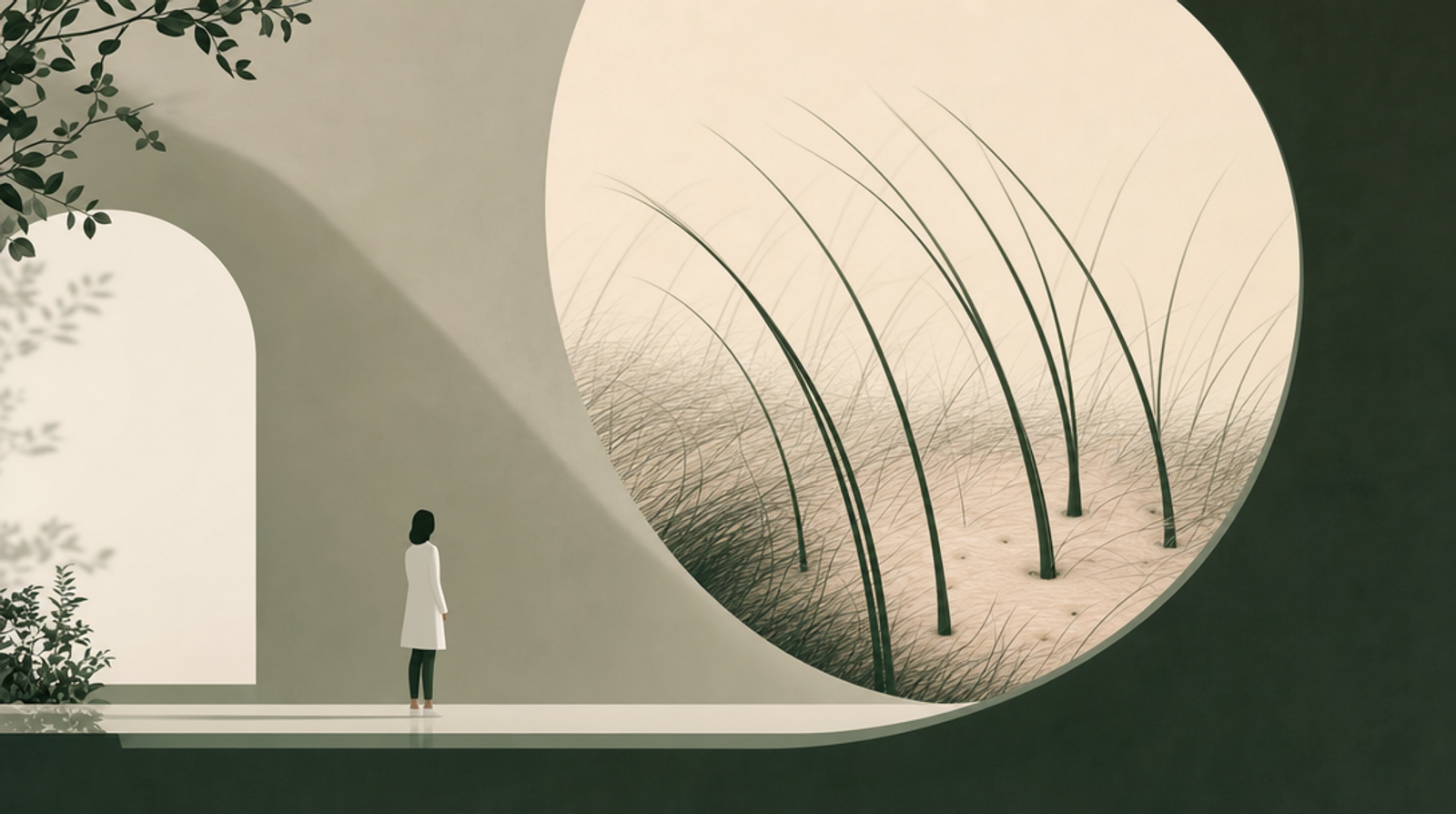
If you've been watching your hair thin out gradually and you're stuck between "maybe it's stress" and "maybe I'm going bald," you're not alone in that limbo. Most of the articles you've already read probably gave you a list of twenty possible causes and left you to figure it out yourself. This one does the opposite. I'll walk you through which causes account for the vast majority of cases, which ones get missed more often than they should, and what signs tell you it's time to stop guessing. In roughly that order of usefulness.
What's the short answer for the most common case?
Most gradual hair thinning in adults is androgenetic alopecia, or pattern hair loss driven by a hormone called DHT. In men, it typically shows up as a receding hairline, thinning at the crown, or both. In women, it tends to present as diffuse thinning across the top of the scalp with the hairline mostly preserved. If your hair loss has been slow, progressive, and follows one of those patterns, androgenetic alopecia is the most likely explanation by a wide margin. The rest of this article walks through how to confirm that, what else it could be, and what actually helps.
What does "hair thinning" actually mean?
People describe hair thinning in a lot of different ways. "My ponytail is thinner." "I can see my scalp through my hair now." "I'm shedding more than I used to." "My hair just looks flat." These are all real observations, but they can point to different things.
There's a difference between shedding and thinning. Shedding means you're losing more full-length hairs than usual. You see them on your pillow, in the drain, on your shirt. Thinning means the individual hairs themselves are getting finer and weaker over time, so your scalp becomes more visible even if you're not losing dramatically more hairs per day. You can have both at the same time. Knowing which one you're noticing helps narrow down what's going on.
What are the most common causes, and how do they typically present?
-
Androgenetic alopecia (pattern hair loss). This is the most common cause of progressive hair thinning in both men and women. It's driven by DHT, a form of testosterone that binds to hair follicles and gradually miniaturizes them until they stop producing visible hair. In men, it follows predictable patterns: temples recede, crown thins, the two zones eventually meet. In women, the part line widens and the top of the scalp thins diffusely. It's gradual, it doesn't itch or hurt, and it doesn't happen overnight. If your thinning fits this pattern, this is the most likely answer.
-
Telogen effluvium (stress-related shedding). This is the second most common cause. A physiological stressor like surgery, illness, crash dieting, a major life event, or a big hormonal shift like postpartum pushes a large percentage of your hair follicles into the resting phase at the same time. Two to four months later, those hairs all fall out together. You notice clumps in the shower, hair everywhere. The distinction from androgenetic alopecia: telogen effluvium usually has a triggering event you can point to, it comes on over weeks rather than years, and the shedding is diffuse rather than patterned.
-
Nutritional deficiency, especially iron. Low ferritin (your body's iron storage protein) is an underappreciated contributor to hair thinning, particularly in premenopausal women. Roughly 1 in 5 premenopausal women have ferritin levels below the threshold where hair quality starts to suffer [per Trost et al., J Am Acad Dermatol, 2006]. Your hemoglobin can be totally normal. You're not "anemic." But your ferritin is low enough to affect hair growth. This one gets missed constantly because standard blood work doesn't always include ferritin unless someone thinks to order it.
-
Thyroid dysfunction. Both hypothyroidism and hyperthyroidism can cause diffuse hair thinning. The hair tends to feel dry and brittle with hypothyroidism. Other clues: fatigue, weight changes, cold or heat intolerance, changes in skin texture. Thyroid-related hair loss is diffuse and doesn't follow a male or female pattern.
-
Seborrheic dermatitis and scalp inflammation. This one surprises people. Chronic dandruff or seborrheic dermatitis creates low-grade scalp inflammation that can contribute to hair thinning over time. People tend to think of dandruff and hair loss as completely separate problems, but they're not. If your scalp is flaky, itchy, or red, that's worth addressing as part of the hair picture.
What are the less common causes that still get missed?
-
Iron deficiency without anemia. I mentioned this above, but it deserves its own line because it's the most commonly missed contributor to hair thinning that I see in practice. A patient comes in with thinning hair. Their CBC is normal. Nobody checked ferritin. Or they checked ferritin and it came back at 25 ng/mL, which is technically "within range" on the lab report but is below the level where hair follicles have what they need. A ferritin under 40–50 ng/mL is worth treating in someone with hair thinning, even if the lab flags it as normal.
-
Early androgenetic alopecia misread as telogen effluvium. This happens more than it should. A patient notices increased shedding and assumes, or gets told, it's stress-related. But when you actually look at the pattern with a dermatoscope, the miniaturization is already there. The shedding isn't random; it's concentrated in the areas where pattern loss happens. The treatment for androgenetic alopecia is completely different from the treatment for telogen effluvium, so getting this wrong means months of doing the wrong thing.
-
Traction alopecia. Hair loss from chronic tension on the follicles: tight ponytails, braids, extensions, headbands worn in the same position daily. It typically shows up at the hairline or temples. It's gradual, it's painless, and it's often attributed to "just getting older" when it's actually mechanical. Caught early, it's reversible. Caught late, the follicles scar and the loss becomes permanent.
-
Medication-related thinning. Several common medications can contribute to hair thinning as a side effect: certain blood pressure medications, antidepressants, hormonal contraceptives (or discontinuing them), and others. This gets missed because the hair change often starts months after starting the medication, so the patient doesn't connect the two.
Red flags that mean: don't wait
Hair thinning on its own is almost never a medical emergency. There are no stroke-level, call-911 red flags for gradual hair loss. That said, there are signs that warrant prompt attention:
If you have any of the following, it's worth getting a doctor's eyes on it, and that's exactly what the chat consultation is for:
- Sudden, rapid hair loss over days to weeks. Not the gradual thinning described above, but patches appearing quickly or large amounts of hair coming out in clumps.
- Smooth, well-defined bald patches (could indicate alopecia areata, which benefits from early treatment).
- Scalp pain, burning, or scarring alongside hair loss (raises concern for a scarring alopecia, which can cause permanent loss if untreated).
- Hair thinning accompanied by other new symptoms: significant fatigue, unintentional weight changes, new skin changes, menstrual irregularities, anything that suggests a systemic cause.
- Hair loss in a child or adolescent. The differential is different and warrants evaluation.
How do you figure out which one is yours?
Ask yourself these questions. They won't give you a diagnosis, but they'll narrow the field considerably.
-
Where is the thinning happening? If it's concentrated at the temples, crown, or along the part line, that points toward androgenetic alopecia. If it's diffuse and all over, think telogen effluvium, thyroid, or nutritional deficiency.
-
How fast did it start? Gradual over months to years favors androgenetic alopecia. A noticeable increase in shedding over weeks, especially with a triggering event 2–4 months prior, favors telogen effluvium.
-
Can you identify a trigger? Surgery, illness, crash diet, major stress, starting or stopping a medication, childbirth. Any of these 2–4 months before the shedding started points toward telogen effluvium.
-
Is your scalp itchy, flaky, or red? If yes, seborrheic dermatitis or another inflammatory scalp condition may be contributing.
-
Do you wear your hair in tight styles regularly? Traction alopecia follows the tension pattern: hairline, temples, wherever the pull is strongest.
-
Have you had blood work recently? If not, a basic panel including ferritin, TSH, and CBC can rule in or out some of the most common non-pattern causes.
-
Does hair loss run in your family? A strong family history of thinning, on either side, raises the probability of androgenetic alopecia significantly.
What can you try at home?
For the most common causes, there are a few reasonable things to start with.
-
If you suspect androgenetic alopecia: Over-the-counter minoxidil (5% for men, 2% or 5% for women depending on formulation) is a reasonable first step. It takes about four months of consistent daily use before you can judge whether it's working. Consistency is the most important part of improvement, and it's entirely under your control.
-
If your scalp is flaky or itchy: Try a ketoconazole 1% shampoo (Nizoral is the most common OTC version) two to three times per week. Let it sit on the scalp for five minutes before rinsing. Addressing scalp inflammation can make a real difference in hair quality.
-
If you suspect a nutritional issue: Don't start megadosing supplements blindly. Get ferritin, vitamin D, and thyroid levels checked first. Supplementing iron when your ferritin is already normal won't help your hair and can cause side effects.
-
Avoid crash diets and dramatic caloric swings. These are a direct trigger for telogen effluvium. If you're changing your diet or ramping up exercise, do it gradually.
What you can't do at home is address the root hormonal driver of androgenetic alopecia. Minoxidil helps regrow hair, but it doesn't block DHT, the hormone that's miniaturizing your follicles. For that, you need finasteride, which requires a prescription and a doctor who knows how to use it. Most patients who've tried minoxidil alone and plateaued are in exactly that position. Minoxidil slowed things down, but it's not enough on its own because it's not addressing the cause.
When is it worth asking a doctor?
Most people who notice their hair thinning wait. They wait because scheduling an appointment means taking time off work, booking weeks out, and sitting in a waiting room for a problem they're not even sure is "real enough" to bring up. So they try minoxidil, or biotin, or a new shampoo, and six months later they're in the same spot or worse, because the working diagnosis was wrong, or because they needed something they couldn't get without a prescription.
On FutureClinic the chat consultation is real healthcare: diagnoses, prescriptions, labs, between you and a real doctor, just through chat. Same medicine, same depth, same doctor staying with you afterwards. What's different is that you start it from your phone whenever you're ready, and most replies come back the same day.
You can either keep trying to sort this out with online articles and OTC products, or you can spend fifteen minutes in a chat with a real doctor who can look at your photos, review your history, order the right labs, and write the prescription if that's what you need. No booking, no video calls, no waiting room. Same doctor for the follow-up if you want to adjust the plan later.
What will a doctor actually do with this?
A dermatologist evaluating hair thinning through chat will typically start with a detailed history: when you first noticed the thinning, where it's happening, how fast it's progressed, any triggering events, your medication list, family history of hair loss, and your scalp symptoms.
Photos are genuinely useful here. Clear photos of the hairline, crown, part line, and any areas of concern, taken in good lighting, give a dermatologist a lot to work with. A dermatoscope (which your dermatologist uses in person) reveals miniaturization patterns, but well-taken photos can show pattern distribution, density changes, and scalp surface findings that help narrow the diagnosis.
If the picture points toward androgenetic alopecia, the next step is usually treatment, not more testing. For most presentations, the doctor can start treatment based on your history and photos; how you respond confirms the diagnosis or tells us to pivot. Finasteride (oral or topical) plus minoxidil is the standard combination. Labs aren't always necessary for straightforward pattern hair loss, but if the picture is ambiguous or there are signs suggesting a contributing factor like fatigue, menstrual changes, or dietary history, the doctor will order targeted labs: ferritin, TSH with reflex free T4, CBC, and possibly a hormonal panel.
If something in the presentation raises concern for a scarring alopecia or another condition that needs a biopsy, your FutureClinic doctor can recommend in-person evaluation for that specific step. But that's the exception, not the starting point. Most hair thinning evaluations resolve through chat, and the same doctor stays with you to monitor your response and adjust the plan over time.
The honest take
Here's what I want you to take away from this article, because the internet gets this one wrong in both directions.
The fear-mongering side tells you hair loss is irreversible and you need to panic. The dismissive side tells you it's "just stress" and it'll grow back. The truth is somewhere in between, and the specifics matter.
If your thinning is androgenetic alopecia, and statistically it probably is, the good news is that we have treatments that genuinely work. Finasteride blocks the hormone that's causing the problem. Minoxidil stimulates regrowth. Used together and used consistently, most patients see meaningful improvement. The bad news is that these treatments work best when started early, and every month you spend trying to figure it out on your own is a month where miniaturization continues.
I used to recommend topical finasteride pretty confidently as a way to get the benefits while avoiding side effect concerns. My thinking has shifted. Oral finasteride is more effective. It improves hair quality across the entire scalp, not just where you apply a topical. And the side effect story for topical finasteride is overstated. There's still systemic absorption. You're reducing the risk of side effects somewhat, not eliminating it. Different dermatologists will weigh this tradeoff differently, and that's a legitimate disagreement. Picking a doctor whose reasoning matches how you think about risk is part of what choosing your FutureClinic doctor lets you do.
The side effects people worry about, changes in libido and sexual function, are real but rarer than the internet makes them seem. In my practice, I don't see them often. When I do, they're usually manageable. We adjust the dose, switch the route, or in some cases they resolve on their own. The important thing is having a doctor who knows these medications well and can help you figure out whether what you're experiencing is actually a side effect or normal day-to-day variation. That coaching relationship makes all the difference.
Frequently asked questions
Does hair thinning always mean I'm going bald?
No. Hair thinning has several possible causes, and many of them are treatable or reversible. Telogen effluvium (stress-related shedding) typically resolves on its own once the trigger is removed. Nutritional deficiencies improve with supplementation. Even androgenetic alopecia, the most common cause, responds well to treatment when caught early. "Thinning" is not the same as "permanent loss."
How long does it take to know if treatment is working?
For finasteride and minoxidil, expect a minimum of four months before you see visible changes, and twelve months for the full picture. Around month three, a dermatologist can often see early signs of improvement with a dermatoscope that aren't visible to the naked eye yet. If you bail at month four because nothing looks different in the mirror, you're quitting right before the payoff starts.
Can hair thinning be caused by stress alone?
Yes, but with a specific mechanism. Acute physiological or emotional stress can trigger telogen effluvium, where a large percentage of hair follicles shift into the resting phase simultaneously and shed 2–4 months later. This is different from the chronic, slow miniaturization of androgenetic alopecia. The distinction matters because the treatment is completely different.
Could my hair thinning be misdiagnosed as something it's not?
It happens more than it should. The most common misread I see is early androgenetic alopecia being dismissed as telogen effluvium. The patient notices shedding, assumes it's stress, and nobody looks closely enough to see the miniaturization pattern underneath. Months go by without the right treatment. A dermatologist who examines the pattern, not just the shedding, catches this.
Should I be worried about finasteride side effects?
The side effects are real, but they're manageable and rarer than the internet makes them seem [per Kaufman et al., J Am Acad Dermatol, 1998]. The volume of fear online is disproportionate to the actual incidence. If you're concerned, a dermatologist who prescribes finasteride regularly can walk you through the risks honestly and help you distinguish normal variation from an actual side effect. Having that relationship, someone who knows your case and can adjust, is what makes the difference.
Is topical finasteride safer than oral?
Topical finasteride does reduce systemic DHT exposure compared to oral, which means the side effect profile is somewhat better. But "somewhat" is the key word. There's still systemic absorption with the topical version. You're not eliminating the risk, you're reducing it. Meanwhile, oral finasteride works across the entire scalp and tends to produce better results in practice. The tradeoff isn't as clean as it's often marketed.
Can a dermatologist really evaluate hair loss through chat?
Yes. Hair thinning evaluation is primarily history-driven: when it started, where it's happening, how fast, what else is going on, plus visual assessment of the pattern. Clear photos in good lighting give a dermatologist a lot of the information they need. Labs can be ordered through chat. Treatment can be prescribed through chat. The same doctor stays with you to monitor your response and adjust over time. If something in the presentation genuinely requires an in-person look, like a biopsy for a suspected scarring alopecia, your doctor can recommend that specific step.
This article is intended as educational information, not personal medical advice. For one-to-one guidance on your specific situation, talk to your own doctor — or start a chat consultation with a FutureClinic doctor and get a real, personalized answer for your case.
References
- Kaufman KD, Olsen EA, Whiting D, et al. Finasteride in the treatment of men with androgenetic alopecia. J Am Acad Dermatol, 1998;39(4):578-589.
- Trost LB, Bergfeld WF, Calogeras E. The diagnosis and treatment of iron deficiency and its potential relationship to hair loss. J Am Acad Dermatol, 2006;54(5):824-844.
- Piraccini BM, Alessandrini A. Androgenetic alopecia. Drugs, 2014;74(11):1165-1175.
- Mella JM, Perret MC, Manzotti M, Catalano HN, Guyatt G. Efficacy and safety of finasteride therapy for androgenetic alopecia: a systematic review. Arch Dermatol, 2010;146(10):1141-1150.
- American Academy of Dermatology. Hair loss: diagnosis and treatment. 2024.
Frequently asked questions
- What is the most common cause of gradual hair thinning in adults?
- The most common cause is androgenetic alopecia, also called pattern hair loss. It's driven by DHT, a hormone that gradually miniaturises hair follicles. In men it typically shows as a receding hairline or thinning crown; in women it presents as diffuse thinning across the top of the scalp with the hairline mostly preserved.
- What is the difference between hair shedding and hair thinning?
- Shedding means you're losing more full-length hairs than usual — visible on your pillow, in the drain, or on your clothes. Thinning means individual hairs are becoming finer and weaker over time, making the scalp more visible even without a dramatic increase in daily hair loss. Both can happen at the same time.
- What is telogen effluvium and how is it different from pattern hair loss?
- Telogen effluvium is stress-related shedding triggered by a physiological event — such as surgery, illness, crash dieting, or postpartum hormonal shifts — that pushes many follicles into the resting phase simultaneously. The shedding appears 2–4 months after the trigger, is diffuse rather than patterned, and usually has a clear starting point, unlike the slow, progressive nature of androgenetic alopecia.
- Can low iron cause hair thinning?
- Yes. Low ferritin — the body's iron storage protein — is an underappreciated contributor to hair thinning, particularly in women. It's worth checking ferritin levels if you're experiencing diffuse shedding, as correcting a deficiency can support hair regrowth.
- How do I know when to stop guessing and see a doctor about hair loss?
- If your thinning is progressive, follows a recognisable pattern, or is accompanied by other symptoms such as scalp itching, pain, or patchy loss, it's worth getting a professional assessment. A dermatologist can examine the pattern, run targeted blood tests, and rule out causes that are easy to miss on your own.
Related articles

When OTC Acne Products Stop Working, What Should You Actually Do Next?
Most OTC acne products don't stop working; they were never matched to the right type of acne in the first place. Here's how to tell when you've given them a fair shot and what a dermatologist can actually do differently.
OTC Acne Products vs. Prescription Acne Treatment: How to Know When You Need a Dermatologist
Cycling through drugstore acne products without results usually isn't a product problem; it's a signal that your acne has outgrown what OTC can offer. Here's how to tell where you sit on that line, and what the prescription tier actually adds.
Acne: A Complete Dermatologist's Guide
Acne isn't one condition; it's at least three, and treating the wrong subtype is why most OTC products seem to stop working. This guide covers how to identify comedonal, inflammatory, and hormonal acne, and what prescription treatment looks like when it's done right.
Why Did My Acne Products Stop Working? A Dermatologist Walks Through It
Cycling through drugstore acne products without results usually isn't a product problem; it's a targeting problem. A dermatologist breaks down why most OTC routines stall and what it takes to actually clear your skin.