OTC Retinol vs Prescription Tretinoin: How to Know When It's Time to Upgrade
Retinol and tretinoin are not the same molecule at different strengths; they sit at different points in a conversion chain, and that gap explains why consistent retinol users sometimes stop seeing results. Here's how to tell whether your skin has hit a ceiling that only a prescription can clear.
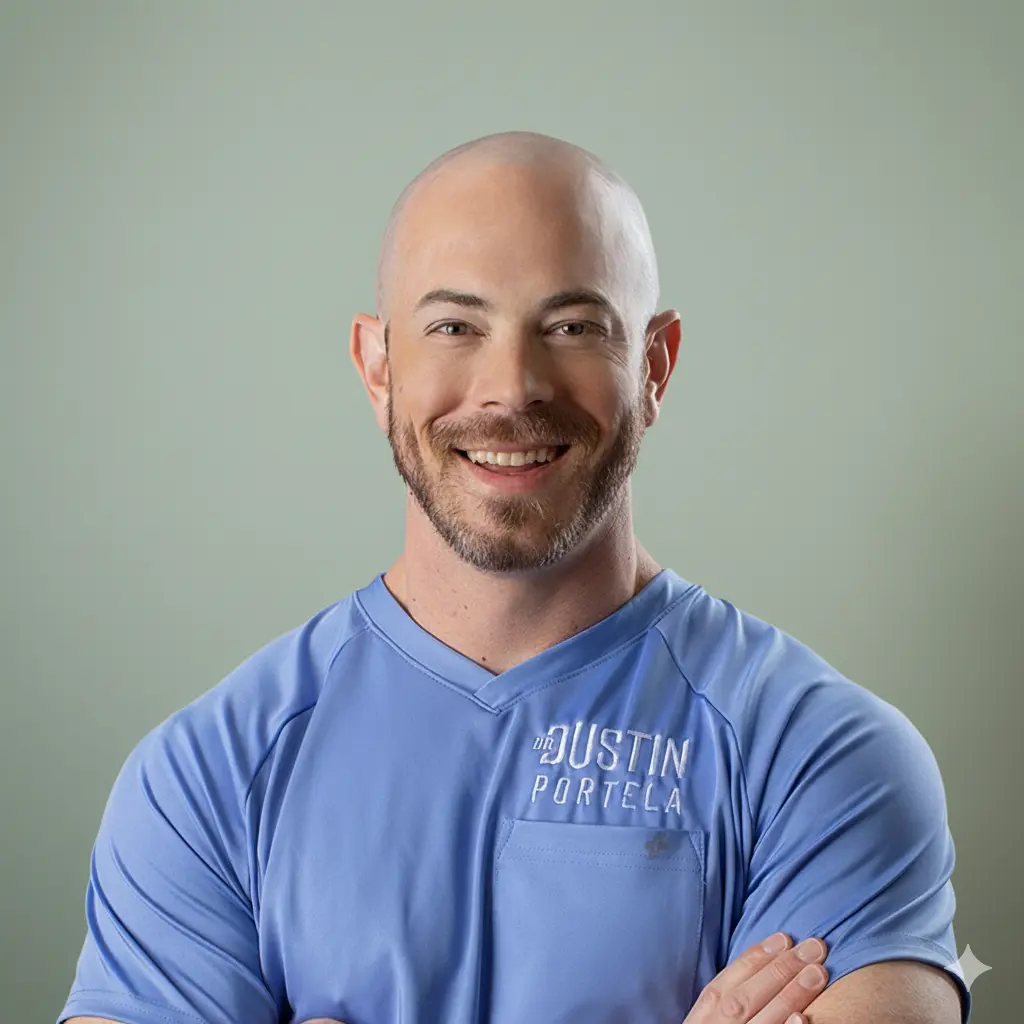
Medically reviewed by Dr. Dustin Portela · Updated August 2026

Most people reading this have been using a retinol for months. Maybe years. You've been consistent, you've been patient, and you're wondering why your skin looks roughly the same as it did six months ago. Meanwhile, you keep hearing that tretinoin is "the real deal" and retinol is just the warm-up act. That framing is half right. Retinol genuinely is enough for some of you. For the rest, the upgrade to prescription tretinoin is overdue, and the reason has nothing to do with willpower or product quality. It has to do with a bottleneck in your skin's chemistry that no amount of retinol can overcome.
What's the real difference between retinol and tretinoin?
Retinol and tretinoin both belong to the retinoid family, but they are not the same molecule at different strengths. They sit at different points in a conversion chain, and that distinction changes everything about how they perform on your skin.
Your skin cells respond to exactly one molecule: retinoic acid. That's the finished, active form that binds to retinoic acid receptors inside your cells and tells them to speed up turnover, produce more collagen, and unclog pores. Nothing happens until retinoic acid docks into those receptors.
Tretinoin is retinoic acid. It's the finished molecule, delivered directly. When it hits your skin, it goes straight to work. No conversion required. That's why it's prescription-strength, why it works faster, and why it tends to be more irritating. You're hitting the receptors at full force from the start.
Retinol is two chemical steps upstream. Your skin has to convert retinol into retinaldehyde, then convert retinaldehyde into retinoic acid, before anything happens. Each step is an enzymatic conversion, and each step is lossy. Some of the retinol degrades or gets lost along the way rather than completing the relay. The commonly cited ballpark is that retinol is roughly ten or more times weaker than tretinoin, though the exact figure depends on formulation and your individual skin [per Mukherjee et al., J Clin Aesthet Dermatol, 2006].
That built-in throttle is also retinol's main advantage. Because the conversion meters out the active molecule gradually, retinol tends to be gentler. Less redness, less peeling, less irritation. That's why it's available over the counter. Tretinoin skips the throttle entirely.
One useful footnote: retinaldehyde, the middle step, is sold on its own as a compromise. It's one conversion step away from active, so it's stronger than retinol but usually gentler than tretinoin. Products further upstream, like retinyl palmitate and retinyl acetate, sit even further back in the chain and are noticeably weaker.
Where OTC retinol is genuinely enough
This is the section most retinol-vs-tretinoin articles skip, because most of them are quietly trying to sell you a prescription. So let me give you the honest case for staying on retinol.
- You're in your twenties or early thirties using a retinoid primarily for prevention. At this age, the most effective anti-aging move is daily sunscreen, not a stronger retinoid. A well-formulated OTC retinol on top of that is doing real work: maintaining turnover, supporting collagen production, keeping pores clear. You don't need prescription-level potency to protect skin that hasn't accumulated significant photodamage yet.
- You've been using your retinol and you're seeing results you're happy with. If your skin is smoother, your tone is more even, and you aren't experiencing irritation, there is no reason to increase potency. More is not always more. Bumping to a stronger retinoid when your current one is working just risks irritation that sets your progress back.
- You have sensitive or reactive skin and your retinol is the highest tier you can tolerate without chronic redness or flaking. Tolerability is the ceiling for some people, and that's fine. A retinoid that your skin can actually use consistently will always outperform a stronger one that you have to keep stopping because your barrier can't handle it.
- You're using retinol primarily for mild acne and it's keeping things under control. For mild comedonal acne, a decent OTC retinol used consistently is a legitimate long-term strategy.
If any of those profiles sound like you, your retinol is doing its job. Don't let FOMO push you into a prescription you don't need.
Where prescription tretinoin actually matters
The honest case for upgrading is equally specific.
- You've been using a well-formulated OTC retinol for four to six months and you can't point to a visible change. Sometimes the honest answer is that your retinol isn't delivering enough active retinoic acid to your skin cells to make a meaningful difference. That doesn't mean you wasted your time. It means you've proven your skin can tolerate a retinoid, and now the conversion bottleneck is the limiting factor.
- Your primary goal is reversing existing photodamage, not just prevention. Brown spots, fine lines, texture changes. Tretinoin has a deeper evidence base for reversing established photoaging than OTC retinol does. The direct delivery of retinoic acid matters more when you're asking the skin to remodel, not just maintain [per Kang et al., J Invest Dermatol, 2005].
- You're in your forties or older and noticing changes your current products aren't keeping up with. I see this patient constantly. Her routine was solid. Her skin changed, and her products didn't keep pace. The upgrade isn't about throwing out everything she's been doing. It's about recognizing the moment when over-the-counter has taken her as far as it can.
- You've tried adapalene or retinol for acne and it's not cutting it. Tretinoin's stronger receptor activation can break through where milder retinoids plateau, particularly for moderate inflammatory acne.
In these profiles, the prescription isn't an upsell. It's the clinically appropriate next step.
How do the side effects compare?
Both retinol and tretinoin cause some degree of retinoid dermatitis (dryness, peeling, redness) especially in the first few weeks. The difference is intensity and duration.
OTC RetinolPrescription TretinoinTypical irritationMild dryness, occasional flaking. Usually resolves within 2–3 weeks.Visible peeling and redness in weeks 2–6 for the majority of new users.OnsetGradual. The conversion throttle buffers the impact.Faster. Retinoic acid hits receptors immediately.Most common reason people quit"I don't think it's doing anything.""My skin is too irritated to continue."PhotosensitivityMildly increased. Sunscreen is non-negotiable, but the fear of extreme sun sensitivity is overstated for topical retinoids. Most of that reputation comes from oral isotretinoin, where the effect is more significant [per Epstein, J Am Acad Dermatol, 1997].Slightly more than retinol, but still commonly overstated.PregnancyContraindicated. All topical retinoids should be avoided during pregnancy.Contraindicated. Same rule applies.
The irritation from tretinoin is almost always manageable. Most people who quit do so because they were using too much, applying to damp skin, or layering too many actives at once. Not because their skin fundamentally can't tolerate it. The fix is usually technique, not a different product.
Something most people don't realize: you can message a doctor about side effects from your OTC retinol too, not just the prescription. If your retinol is causing persistent dryness or you're not sure whether what you're seeing is normal adjustment or a sign to stop, that's a conversation worth having. On FutureClinic, side-effect management isn't a one-shot conversation. The same doctor tracks how your skin responds over time and adjusts the plan, whether you're on the OTC option or the prescription.
What does each one look like day to day?
OTC retinol:
- Where to buy: Any drugstore, Sephora, Ulta, or online. RoC is a brand I frequently recommend for a well-formulated, reasonably priced option. If you want something stronger than retinol but aren't ready for a prescription, retinaldehyde products from Prequel Skin or Avène are a solid middle ground, one conversion step closer to the active form.
- How to use: Apply a pea-sized amount to dry skin at night. Dot it across your forehead, cheeks, chin, and nose, then rub it in. Moisturize after. Start every other night and work up to nightly as tolerated.
- Forgiveness factor: High. Miss a night, nothing dramatic happens. The gradual conversion means consistency matters more than perfection.
Prescription tretinoin:
- How to access: Requires a prescription from a doctor. A chat consultation is enough. The doctor reviews your skin, your history, and your goals, and writes the prescription if it's the right call.
- How to use: Same application technique. Pea-sized amount, dry skin, nighttime. Avoid the corners of the nose and the immediate eye area. Moisturize after. Start every second or third night with the goal of reaching nightly use by the end of the first month.
- Starting strength: If you're new to retinoids entirely, 0.025% is a common starting point. If you've been using OTC retinol consistently without sensitivity issues, 0.05% is reasonable. The 0.1% concentration is reserved for people who have tolerated the lower strengths without problems.
- Forgiveness factor: Lower in the early weeks. Skipping nights during the adjustment period is expected and intentional. It's part of the titration, not a failure.
One critical technique note: do not use the sandwich method. That's when you apply moisturizer, then tretinoin, then another layer of moisturizer. The intention is to buffer irritation, but the data shows it completely neutralizes the retinoid. You're paying for a prescription and then blocking it from doing its job. Apply tretinoin directly to dry skin, then moisturize over it.
Why is a straight answer on this so hard to find online?
Most digital health companies in this space make their money on the prescription itself. They're a pharmacy with a doctor in the lobby. The structural incentive is to land you on the prescription even when the OTC option would be enough. That's not a conspiracy. It's the business model. Once you see it, the consistent "you should really get the prescription" tone of most online coverage makes sense.
I don't earn more if I prescribe tretinoin than if I tell you your retinol is fine. On FutureClinic, the doctor charges for the consultation, not the prescription. Whether the consult ends with "stay on your retinol, here's how to use it better" or with a tretinoin prescription, the outcome for me is the same. That structural neutrality is what lets me give you the no-upsell answer. And it's also why the consult is worth doing even when the answer turns out to be OTC. Getting started on the right product, using it correctly, and having the same doctor in the loop if things aren't working at week eight is what the conversation delivers.
Who fits each path?
- Stay on OTC retinol if you're seeing steady progress, your skin tolerates it well, you're primarily focused on prevention rather than reversal, or you have reactive skin that can't handle stronger formulations. Your retinol is working. Don't fix what isn't broken.
- Upgrade to prescription tretinoin if you've given a quality OTC retinol an honest four-to-six-month trial with no visible improvement, your goals have shifted toward reversing existing photodamage rather than just preventing it, or you've hit a plateau you can't explain with technique alone.
- The gray zone: you've seen some results from retinol but you're not sure if you're getting everything you could. This is the most common profile I see. What tips it: if your primary concern is fine lines and brown spots that appeared in the last two to three years, and your retinol hasn't visibly moved them in four-plus months of consistent use, the conversion bottleneck is likely the limiting factor, and tretinoin is the logical next step. If your primary concern is texture and pore size and your retinol has been helping, you may have more runway on the OTC tier before needing to escalate.
How to succeed on OTC retinol (if that's your answer)
If your situation is genuinely OTC-tier, here's how to make it work.
- Pick a well-formulated product. Cheap retinol products are unlikely to show meaningful results. This is at least a mid-tier purchase. RoC is a brand I recommend frequently. If you want something closer to prescription strength without the prescription, retinaldehyde products from Prequel Skin or Avène are worth looking at.
- Apply to dry skin at night. Wait until your face is fully dry after cleansing. Damp skin increases penetration and increases irritation. That's one of the most common mistakes I see.
- Use a pea-sized amount. Dot it across your forehead, cheeks, chin, and nose, then blend. Moisturize after.
- Do not layer it with other chemical exfoliants in the same routine. Retinol plus AHA plus vitamin C in the same evening is a recipe for destroying your skin barrier. Separate your actives.
- Give it a real timeline. You're looking for visible changes at the eight-to-twelve-week mark, not week two. Patience isn't a weakness in skincare. It is the strategy.
- What "it's working" looks like: By week four, your skin should feel smoother to the touch. By week eight, you should see more evenness in tone. By week twelve, fine lines should look softer and any mild discoloration should be fading. If you're at week twelve and you can't point to any of those changes, the retinol has likely taken you as far as it can.
- Sunscreen is non-negotiable. Unprotected sun exposure will negate the positive effects of any retinoid. You can't out-retinol the sun.
The honest take, and how to know when it's time to escalate
Here's what I tell my patients: if your retinol is working, stay on it. I used to believe you had to push for the strongest retinoid your skin could tolerate and use it continuously. I don't believe that anymore. Now I think in terms of the lowest effective dose, the concentration that gets results without causing additional problems. If your skin is happy and improving, I'm not bumping you to something stronger just because it exists. The goal is progress, not punishment.
But if you've been on a quality OTC retinol for four to six months and your mirror hasn't changed, the bottleneck is probably the conversion. Your skin can only convert so much retinol into retinoic acid, so fast, and some of it gets lost along the way. At that point, the upgrade to tretinoin isn't about being more aggressive. It's about removing a bottleneck that no amount of retinol can fix.
The escalation signals are specific. If your fine lines haven't softened by month four, if your brown spots haven't faded by month three, if your overall texture and brightness haven't shifted by month three, and you've been using the product correctly on dry skin, at night, with sunscreen during the day, that's the conversation about whether to move to a prescription.
I draw the line at the four-to-six-month mark for most patients. Other dermatologists draw it earlier or later, and both are legitimate. Picking the doctor whose threshold matches what you're looking for is part of what choosing your FutureClinic doctor lets you do.
That escalation conversation is a real consultation with a real doctor. The same doctor who knows what you've already tried, what your skin looks like, and what your goals are. It's real healthcare: diagnoses, prescriptions, labs, just through chat, between you and a doctor. You start it from your phone whenever you're ready, and you'll usually hear back the same day. You can keep re-reading articles and second-guessing your routine, or you can spend fifteen minutes in a chat with a doctor who can look at your photos, review what you've tried, and write the prescription if that's the right call. Same day, no booking, same doctor for the follow-up.
Frequently asked questions
Is OTC retinol the same molecule as prescription tretinoin?
No. They are different molecules in the same retinoid family. Retinol is a precursor that your skin must convert through two enzymatic steps into retinoic acid, the active form. Tretinoin is retinoic acid, delivered directly. The prescription version is not just "a stronger retinol." It's a different point in the conversion chain.
Will retinol thin my skin?
Retinol thins the stratum corneum, the outermost layer of dead skin cells, but thickens the deeper layers where collagen lives. The net effect is structurally thicker, healthier skin over time. The thinning people worry about is happening at the surface layer you want to thin. The thickening is happening in the layer that actually matters for structure and aging [per Varani et al., J Invest Dermatol, 2000].
Can I get tretinoin over the counter anywhere?
Not in the United States. Tretinoin requires a prescription. Some countries sell it over the counter, but in the US, you need a doctor to prescribe it. A chat consultation is enough to get that prescription if it's clinically appropriate.
Do I really need to worry about sun sensitivity on a topical retinoid?
You need sunscreen, that's non-negotiable, but the fear of extreme photosensitivity from topical retinoids is overstated. Most of that reputation comes from oral retinoids like isotretinoin, where the effect is more significant. With topical retinol or tretinoin, the risk of sunburn is slightly increased, but it's not radically higher. Don't let that fear stop you from using a retinoid.
Is bakuchiol a real alternative to retinol?
No. Bakuchiol does not work through the same mechanism as retinol. It does not bind to retinoic acid receptors. There are very few robust studies supporting it as an equivalent. It may have some anti-inflammatory properties, but calling it "nature's retinol" is marketing, not science. The same goes for beef tallow, coconut oil, aloe vera, and banana peels. None of these impact the retinoic acid receptors the way retinol or tretinoin can.
Should I always keep increasing the strength of my retinoid?
No. If your current concentration is delivering results and your skin is tolerating it well, there is no reason to go stronger. Let me be blunt: the "always go stronger" mentality in the skincare community drives me crazy. More potency without tolerance is just more irritation, and irritation sets your progress back. The goal is the lowest effective dose.
If my retinol isn't working, could it be my technique rather than the product?
Possibly. The most common mistakes I see: applying to damp skin (increases irritation), using too much product, layering retinol with other chemical exfoliants in the same routine, or using the sandwich method which neutralizes the retinoid entirely. Fix the technique first. If you've been applying correctly for four months and still see nothing, the product is likely the limiting factor, and that's when a conversation about tretinoin makes sense. If you're not sure whether it's technique or product, that's exactly the kind of question a chat consultation can sort out quickly.
This article is intended as educational information, not personal medical advice. For one-to-one guidance on your specific situation, talk to your own doctor, or start a chat consultation with a FutureClinic doctor and get a real, personalized answer for your case.
Bottom line
If your OTC retinol is working, keep using it. Don't let the internet convince you that you need a prescription just because one exists. But if you've given a quality retinol an honest four-to-six-month trial on dry skin, at night, with sunscreen during the day, and your mirror hasn't changed, the bottleneck is the conversion, and tretinoin is how you remove it. The upgrade isn't about being more aggressive. It's about recognizing the moment when over-the-counter has taken you as far as it can.
If you want a personalized plan for your skin, whether that's optimizing your retinol routine or deciding whether tretinoin is the right move, you can start a chat consultation with me through FutureClinic. Same medicine, same depth, same doctor staying with you. What's different is that you start it from your phone whenever you're ready.
References
- Mukherjee S, Date A, Patravale V, et al. Retinoids in the treatment of skin aging: an overview of clinical efficacy and safety. Clin Exp Dermatol, 2006;31(5):625-630.
- Kang S, Duell EA, Fisher GJ, et al. Application of retinol to human skin in vivo induces epidermal hyperplasia and cellular retinoid binding proteins characteristic of retinoic acid but without measurable retinoic acid levels or irritation. J Invest Dermatol, 1995;105(4):549-556.
- Varani J, Warner RL, Gharaee-Kermani M, et al. Vitamin A antagonizes decreased cell growth and elevated collagen-degrading matrix metalloproteinases and stimulates collagen accumulation in naturally aged human skin. J Invest Dermatol, 2000;114(3):480-486.
- Epstein JH. Phototoxicity and photoallergy in man. J Am Acad Dermatol, 1983;8(2):141-147.
- Leyden J, Stein-Gold L, Weiss J. Why topical retinoids are mainstay of therapy for acne. Dermatol Ther (Heidelb), 2017;7(3):293-304.
Frequently asked questions
- Is tretinoin just a stronger version of retinol?
- Not exactly. Tretinoin is retinoic acid, the finished active molecule your skin cells actually respond to. Retinol is two chemical conversion steps upstream, and some of it degrades before completing that relay. They're related but not the same molecule at different doses.
- How much weaker is retinol compared to tretinoin?
- The commonly cited estimate is that retinol is roughly ten or more times weaker than tretinoin, though the exact figure depends on the formulation and individual skin chemistry. The difference comes from the lossy enzymatic conversion retinol must undergo before becoming active.
- Can retinol be enough, or do I always need to upgrade?
- Retinol is genuinely sufficient for some people, particularly those in their twenties or early thirties using a retinoid primarily for prevention, or anyone who has seen continued improvement on their current product. The upgrade to tretinoin is most relevant when results have plateaued despite consistent use.
- What is retinaldehyde, and how does it compare to retinol and tretinoin?
- Retinaldehyde is the intermediate step between retinol and retinoic acid. It's one conversion step away from active, making it stronger than retinol but typically gentler than tretinoin. It's sold in some OTC products as a middle-ground option.
- Why is tretinoin only available by prescription?
- Tretinoin is retinoic acid delivered directly, so it hits skin receptors at full force without any conversion buffer. That makes it more effective but also more likely to cause redness, peeling, and irritation, which is why it requires a prescription and medical oversight.
- How long should I use retinol before considering a switch to tretinoin?
- There's no universal timeline, but if you've been using a well-formulated retinol consistently for several months and have stopped seeing meaningful improvement, that plateau is a reasonable signal to discuss a prescription retinoid with a doctor.
Related articles

When OTC Acne Products Stop Working, What Should You Actually Do Next?
Most OTC acne products don't stop working; they were never matched to the right type of acne in the first place. Here's how to tell when you've given them a fair shot and what a dermatologist can actually do differently.

When OTC Acne Products Stop Working, What Should You Actually Do Next?
Most OTC acne products don't stop working; they were never matched to the right type of acne in the first place. Here's how to tell when you've given them a fair shot and what a dermatologist can do that the drugstore shelf can't.

OTC Acne Products vs. Prescription Acne Treatment: How to Know When You Need a Dermatologist
Cycling through drugstore acne products without results usually isn't a product problem; it's a signal that your acne has outgrown what OTC can offer. Here's how to tell where you sit on that line, and what the prescription tier actually adds.
Acne: A Complete Dermatologist's Guide
Acne isn't one condition; it's at least three, and treating the wrong subtype is why most OTC products seem to stop working. This guide covers how to identify comedonal, inflammatory, and hormonal acne, and what prescription treatment looks like when it's done right.