

Finasteride for Hair Loss, Explained: A Beginner's Guide from a Dermatologist
Finasteride is the most effective medication for treating the root cause of male pattern hair loss, but the internet makes it hard to know where to start. A dermatologist breaks down how it works, oral versus topical, realistic timelines, and what the side effect conversation actually looks like in practice.
Medically reviewed by Dr. Dennis Porto · Updated August 2026
If you've started looking into finasteride and immediately felt like you wandered into the middle of someone else's conversation (oral versus topical, DHT levels, compounding pharmacies, Reddit horror stories about side effects), that's a completely normal place to be. Finasteride is one of those treatments where the internet gives you a fire hose of information and almost none of it is organized for someone just getting started. This is the plain-language version, written by a dermatologist who prescribes finasteride regularly, aimed at the moment you're in right now.
What you actually need to know
-
Finasteride is the most effective medication we have for treating the root cause of male pattern hair loss. It blocks the hormone that shrinks your hair follicles over time. Minoxidil helps, but it doesn't address why the hair is thinning in the first place. Finasteride does.
-
It comes in two forms: a pill you swallow (oral) and a liquid you rub into your scalp (topical). They contain the same active ingredient. The difference is how the medication gets into your system and how much of your body it affects.
-
Oral finasteride generally produces better results than topical. It works across your entire scalp, compliance is simpler, and the evidence behind it is deeper. Topical finasteride is a reasonable option for some people, but it's not the slam-dunk replacement for oral that the internet sometimes makes it sound like.
-
Side effects are real but uncommon. Sexual side effects like changes in libido get an enormous amount of airtime online. They do happen, but they're rarer than the volume of internet discussion would suggest, and they're usually manageable.
-
Results take months, not weeks. Most patients don't see visible improvement until around month six, and the full picture doesn't come together until closer to a year. Quitting early is the most common reason finasteride "doesn't work."
Wait, am I in the right place?
This guide is for you if you're just starting to learn about finasteride. Maybe you've noticed your hair thinning, maybe a friend mentioned it, maybe you've been on minoxidil and you're wondering what else is out there. You don't need any background knowledge to follow along.
If you've already been on finasteride for a while and you're trying to decide whether to switch from one form to the other, or you want a deeper comparison of treatment options, you'd get more out of a Treatment Decision or Condition Deep Dive article on androgenetic alopecia. This guide covers the basics and gets you oriented.
What's actually going on?
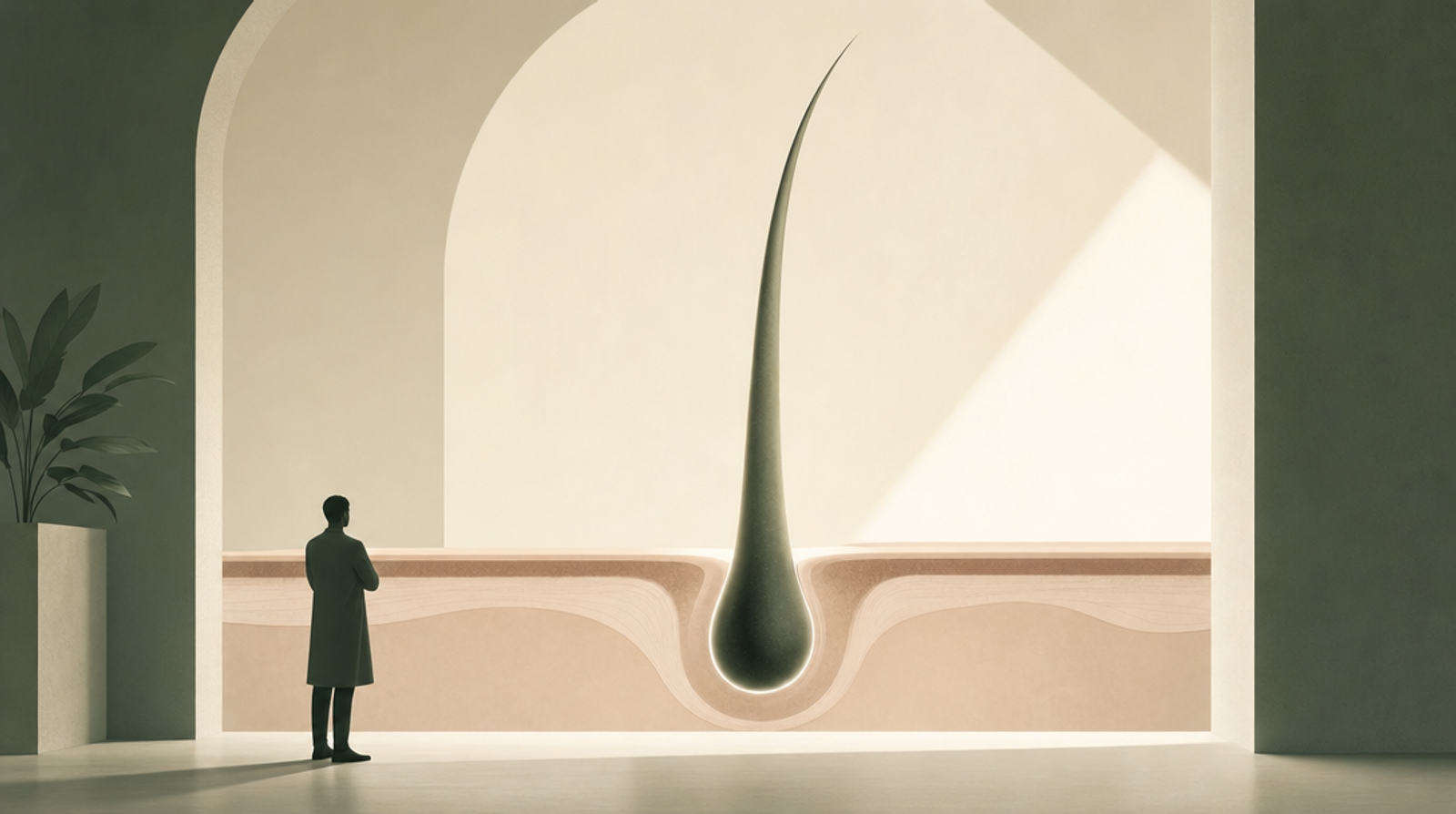
Male pattern hair loss (the medical name is androgenetic alopecia) happens because of a hormone called DHT, which stands for dihydrotestosterone. DHT is a form of testosterone. Your body makes it naturally, and it does useful things during puberty. But in people who are genetically prone to hair loss, DHT gradually shrinks the hair follicles on your scalp. The hairs get thinner and finer over time until eventually the follicle stops producing visible hair altogether.
Finasteride works by blocking the enzyme that converts testosterone into DHT. Less DHT means less follicle shrinkage. That's the whole idea.
Now, for the oral-versus-topical question: when you take finasteride as a pill, it lowers DHT throughout your entire body. In your bloodstream, across your whole scalp, everywhere. When you apply it as a topical, it primarily blocks DHT at the spot where you rub it in. Some of it still gets absorbed into your bloodstream, but less than the pill.
That difference sounds like a clear win for topical. Same benefit, fewer body-wide effects, right? In practice, it's not that clean. The oral version tends to produce better results precisely because it works everywhere. Even hair follicles you haven't noticed thinning yet get protected. The surrounding hair improves in quality and thickness, which makes thinning areas less obvious overall. Topical finasteride only helps the zones where you apply it.
The terms you're going to hear
-
DHT (dihydrotestosterone). The hormone responsible for shrinking hair follicles in androgenetic alopecia. Finasteride works by reducing it.
-
Androgenetic alopecia. The medical term for the most common type of hair loss in men, the kind that runs in families and follows a predictable pattern (temples, crown, front).
-
5-alpha reductase. The enzyme that converts testosterone into DHT. Finasteride is a "5-alpha reductase inhibitor," which just means it blocks that conversion.
-
Minoxidil. A separate hair loss medication (available as a topical liquid, foam, or oral pill) that works through a different mechanism than finasteride. The two are often used together.
-
Compounding pharmacy. A pharmacy that custom-mixes medications. Topical finasteride isn't commercially available as an FDA-approved product, so it's made by compounding pharmacies, and quality varies.
-
Dermatoscope. A magnifying instrument with special lighting that dermatologists use to examine hair follicles up close. It can detect early improvement months before you'd notice anything in the mirror.
-
Telogen effluvium. A type of temporary hair shedding triggered by stress, diet changes, or illness. It's different from androgenetic alopecia but can happen alongside it and make things look worse.
-
Miniaturization. The process of a hair follicle gradually producing thinner, shorter, finer hairs over time. This is what DHT does to your follicles in androgenetic alopecia.
What does the typical path look like?
A consultation for hair loss usually starts with a detailed history: when you first noticed thinning, where on your scalp, family history, what you've tried so far, any other health conditions or medications. If you're working with a dermatologist, they'll often use a dermatoscope to get a close look at the follicle quality and pattern.
From there, finasteride is usually the first-line prescription for men with androgenetic alopecia. The standard approach is oral finasteride, one milligram, once a day. If there's a reason to start with topical instead (typically anxiety about side effects), that's a reasonable alternative, with the understanding that it may not be quite as effective and you can always switch later.
Many patients are already using minoxidil when they start finasteride, and the two work well together. If you're using topical minoxidil, finasteride can sometimes be compounded into the same solution so you're applying one product instead of two.
The timeline is slower than most people expect. Around month three, a dermatologist can usually see early signs of improvement with a dermatoscope: fine new hairs forming. But you won't see anything in the mirror yet. By month six, some patients start noticing less shedding or subtle improvement in photos. Month twelve is when results become hard to miss. Consistency through those early months is the most important factor [per AAD clinical guidelines].
What to actually do next
-
Take photos now. Consistent lighting, same angles, same time of day. You'll want a baseline to compare against in six months. Without photos, it's almost impossible to judge progress accurately because you see your hair every day.
-
If you're already on minoxidil, don't stop it. Finasteride and minoxidil work through different mechanisms and complement each other. Adding finasteride doesn't mean dropping minoxidil.
-
Treat your scalp if it needs it. Seborrheic dermatitis (dandruff) can contribute to hair shedding and is surprisingly common alongside androgenetic alopecia. A prescription-strength antifungal shampoo can help. It's a piece people overlook.
-
Don't crash-diet or dramatically change your exercise routine right when you start treatment. Major caloric swings and metabolic shocks can trigger telogen effluvium, which is temporary shedding that compounds the hair loss you're already dealing with. If you're going to change your diet or ramp up training, do it gradually.
If you're deciding whether to talk to a doctor
The most common reason people sit on this decision isn't that they don't care about their hair. It's the hassle. Scheduling an appointment weeks out, taking time off, sitting in a waiting room, all for a conversation that might take fifteen minutes. The frequent result is self-treating with whatever Reddit recommends, ordering something from a direct-to-consumer brand without real clinical oversight, and then not knowing whether what you're using is actually working or even the right formulation.
On FutureClinic, the consultation is real healthcare: a real diagnosis, a real prescription if it's the right call, real lab orders if they're needed, between you and a real doctor, just through chat. You start it from your phone whenever you're ready, and you'll usually have a response back the same day. The same doctor stays with you for follow-ups, so when you hit month three and want to know whether what you're seeing is progress or not, you message the same person who started your treatment. You can keep researching this on your own, or you can spend the same fifteen minutes in a chat with a dermatologist who can look at your photos, review your history, and write the prescription if it makes sense for your case.
Common mistakes new patients make
-
Quitting at month three or four because they don't see results yet. Visible improvement typically doesn't show up until month six at the earliest. Stopping before that is like walking out of a movie at the halfway point and saying nothing happened.
-
Confusing "stabilization" with "failure." Finasteride stops further hair loss in most patients. That's a genuine win, but if you were expecting dramatic regrowth and instead got "it stopped getting worse," it can feel disappointing. Stabilization means the medication is working.
-
Assuming topical finasteride is side-effect-free. Topical finasteride does reduce systemic DHT exposure compared to oral, but it doesn't eliminate it. There's still absorption into the bloodstream. The side effect profile is reduced, not removed. Making a decision based on the idea that topical is "completely safe" while oral is "risky" is working from incomplete information.
-
Monitoring every fluctuation in libido or sexual function after starting the medication. Day-to-day variation in libido and erectile quality is normal physiology. It happens whether you're on finasteride or not. Once you start the medication, you're hyper-aware of every change, and it's genuinely hard to separate normal variation from an actual side effect. Working with a doctor who can coach you through the early months makes a real difference here.
-
Using a direct-to-consumer brand without a doctor meaningfully involved in the process. Accessibility matters, and these platforms can be valuable, but only when a board-certified dermatologist is actually overseeing your treatment. Without real clinical oversight, patients end up on formulations that are wrong for them, compounded incorrectly, or never adjusted.
Frequently asked questions
Will finasteride actually regrow hair, or does it just stop further loss?
Finasteride does both, but the primary effect is stopping further loss. Most patients see stabilization, meaning the hair loss stops progressing, and a meaningful subset also see regrowth, particularly in areas where follicles were miniaturized but hadn't shut down completely. The combination of finasteride and minoxidil tends to produce the best regrowth results [per a 2019 meta-analysis in the Journal of the American Academy of Dermatology].
How common are sexual side effects, really?
They're real but uncommon. In clinical trials, sexual side effects like decreased libido occurred in roughly 1-2% of men taking finasteride compared to placebo [per FDA prescribing information for Propecia]. In practice, they're manageable. Dose adjustments, route changes, or simply giving the body time to adjust usually resolve them. The volume of fear online is disproportionate to the actual incidence.
Can I just use topical finasteride and skip the pill entirely?
You can, and for some patients that's a reasonable starting point, especially if side effect anxiety is a real barrier to starting treatment at all. The tradeoff is that topical finasteride tends to be somewhat less effective than oral, only works in the areas where you apply it, and still has some systemic absorption. Starting topical and switching to oral later if needed is a common path.
Do I need to take finasteride forever?
As long as you want to maintain the benefit, yes. Finasteride works by suppressing DHT. If you stop taking it, DHT levels return to baseline and hair loss resumes where it left off. Most patients who respond well stay on it long-term.
Is finasteride safe to use with minoxidil?
Yes. They work through completely different mechanisms and are commonly prescribed together. Finasteride addresses the root cause (DHT), while minoxidil stimulates blood flow to the follicle and promotes growth through a separate pathway.
Can women use finasteride?
Finasteride is sometimes used in women, but only after menopause and at different doses. The risk-benefit considerations are different for women, and it's not a first-line treatment the way it is for men. A dermatologist who treats female hair loss can walk through whether it makes sense for a specific case.
What if I start finasteride and my shedding gets worse at first?
An initial increase in shedding during the first few weeks is normal and expected. It's a sign that the hair cycle is resetting: weaker hairs are being pushed out to make room for stronger ones. It's temporary and not a reason to stop the medication.
Should I get my DHT levels tested before starting?
In most cases, no. Androgenetic alopecia is diagnosed based on the pattern of hair loss and clinical examination, not blood work. DHT levels don't reliably predict who will respond to finasteride or how well. A dermatologist can usually tell you everything you need to know from a thorough history and a dermatoscope exam. If there's suspicion of another cause of hair loss, your doctor might order labs, but that's to rule out other conditions, not to "confirm" androgenetic alopecia.
This article is intended as educational information, not personal medical advice. For one-to-one guidance on your specific situation, talk to your own doctor, or start a chat consultation with a FutureClinic doctor and get a real, personalized answer for your case.
Bottom line
Finasteride is the most effective treatment we have for the root cause of male pattern hair loss. Oral finasteride is generally the stronger option. It works across the entire scalp, compliance is straightforward, and the evidence is deep. Topical finasteride is a reasonable alternative for patients who want to start with a lower-exposure route, with the understanding that it's somewhat less effective and still has some systemic absorption. The side effects are real but uncommon and manageable. The biggest mistake is quitting before the medication has had time to work.
Consistency is the most important part of improvement, and it's entirely under your control.
If you want a prescription that fits your hair loss and a doctor who'll stay with you through the early months to help you read the results, you can start a chat consultation with me through FutureClinic.
References
- Kaufman KD, Olsen EA, Whiting D, et al. Finasteride in the treatment of men with androgenetic alopecia. J Am Acad Dermatol, 1998;39(4 Pt 1):578-589.
- U.S. Food and Drug Administration. Propecia (finasteride) prescribing information. 2012.
- Adil A, Godwin M. The effectiveness of treatments for androgenetic alopecia: a systematic review and meta-analysis. J Am Acad Dermatol, 2017;77(1):136-141.e5.
- Piraccini BM, Blume-Peytavi U, Scarci F, et al. Topical finasteride for androgenetic alopecia: a systematic review. Dermatol Ther, 2022;35(10):e15841.
- American Academy of Dermatology. Hair loss: diagnosis and treatment. 2024.
Frequently asked questions
- How does finasteride treat hair loss?
- Finasteride blocks the enzyme that converts testosterone into DHT (dihydrotestosterone). DHT is the hormone that gradually shrinks hair follicles in people genetically prone to male pattern hair loss. By reducing DHT levels, finasteride slows or stops that shrinkage.
- What's the difference between oral and topical finasteride?
- Both contain the same active ingredient, but oral finasteride lowers DHT throughout the whole body, while topical finasteride is applied directly to the scalp and is absorbed more locally. Oral finasteride generally produces better results and has a stronger evidence base; topical is an option for some patients but isn't a straightforward replacement.
- How long does finasteride take to work?
- Most patients don't see visible improvement until around month six, and the full picture typically doesn't come together until closer to a year of consistent use. Stopping early is the most common reason finasteride appears not to work.
- How common are sexual side effects with finasteride?
- Sexual side effects such as changes in libido do occur, but they are less common than the volume of online discussion suggests. They are also usually manageable. The internet tends to amplify these experiences, which can make the risk seem higher than clinical evidence shows.
- Is finasteride better than minoxidil for hair loss?
- They work differently. Minoxidil can help with hair growth but doesn't address the underlying cause of thinning. Finasteride targets DHT, the hormone responsible for follicle shrinkage in male pattern hair loss. Many patients use both together for a more comprehensive approach.
- Who is finasteride most suitable for?
- Finasteride is primarily used for male pattern hair loss (androgenetic alopecia) in men. It's most effective when started earlier in the hair loss process, before follicles have stopped producing visible hair entirely. A dermatologist can assess whether it's appropriate based on your pattern and history.
Related articles

When OTC Acne Products Stop Working, What Should You Actually Do Next?
Most OTC acne products don't stop working; they were never matched to the right type of acne in the first place. Here's how to tell when you've given them a fair shot and what a dermatologist can actually do differently.
OTC Acne Products vs. Prescription Acne Treatment: How to Know When You Need a Dermatologist
Cycling through drugstore acne products without results usually isn't a product problem; it's a signal that your acne has outgrown what OTC can offer. Here's how to tell where you sit on that line, and what the prescription tier actually adds.
Acne: A Complete Dermatologist's Guide
Acne isn't one condition; it's at least three, and treating the wrong subtype is why most OTC products seem to stop working. This guide covers how to identify comedonal, inflammatory, and hormonal acne, and what prescription treatment looks like when it's done right.
Why Did My Acne Products Stop Working? A Dermatologist Walks Through It
Cycling through drugstore acne products without results usually isn't a product problem; it's a targeting problem. A dermatologist breaks down why most OTC routines stall and what it takes to actually clear your skin.